Introduction – Apis Mellifica: The HoneyBee Remedy
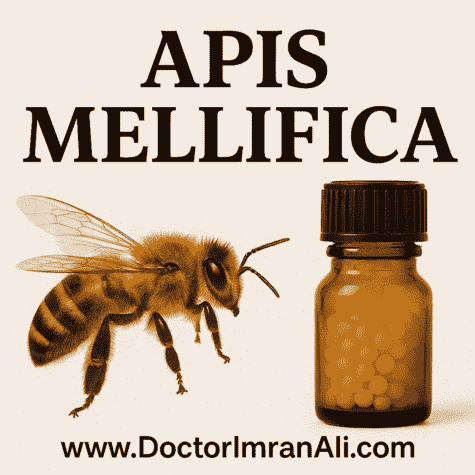
Hi everyone, I’m Dr. Imran Ali, and welcome back to the Homeopathy materia medica series. Today, I’ll be discussing Apis Mellifica. This homeopathic remedy is made from the whole live honeybee. It’s an indispensable remedy used for many acute ailments and a good number of chronic conditions, too.
Okay, so let’s jump right in.
Doctrine of Signatures – Apis and Its Natural Correspondence
All right. So the cool thing about Apis Mel is that it is one of the best examples of the doctrine of signatures that we have in the materia medica.
Which is to say that:
The physical or behavioral attributes of a plant, animal or mineral can sometimes give us an indication of its uses for healing.
In the case of Apis, both its symptom profile and therapeutic indications are almost a direct reflection of the bee itself and of its fascinating behaviors. While most remedies have only a symptom or two or three that correspond to the doctrine of signatures, Apis fits in many ways both physically and emotionally.
Core Symptom Pattern of Apis Mellifica
The symptom pattern that runs throughout Apis Mellifica can be summarized by the following Key Symptoms:
- Heat.
- Redness.
- Inflammation.
- Burning.
- Stinging.
- Dizziness.
- Irritability.
- Swelling.
All of these symptoms are well-known characteristics of the bee, especially an angry bee and the symptoms produced by its sting. Swelling is the most definitive Apis Mellifica symptom of all, the one most important symptom that should alert us to the possibility of this remedy.
Fluid Balance Theme of Apis Mellifica
Swelling is directly related to another theme that runs throughout much of Apis Mellifica’s pathology, and that theme is fluid balance. A great deal of Apis symptomatology has to do with fluid balance, like:
- Swelling,
- Edema,
- Thirstlessness,
- Kidney dysfunction
- Urinary tract dysfunction
Mental and Emotional Picture Of Apis Mellifica
Apis is usually prescribed according to its physical symptoms.
In most acute Apis cases, the mentals are usually not the reason why we choose this remedy.
But when a person fits the type in general or has a chronic condition that fits Apis Mellifica, the mentals can often be quite helpful.
On the mental-emotional level:
Strong & Vital
The Apis Mellifica type tends to be strong and vital.
Active & Busy
They are active and have a busy intensity about them. One might even say busy like a bee.
Workaholism
Many are task-oriented and like worker bees and may tend toward workaholism.
Restless, Nervous
They can also be restless, nervous, and fidgety.
Practical Nature
They tend to be non-nonsense, practical types.
Forceful & Direct
Apis has been described as being forceful(powerful) and direct.
Straightforward
They are straightforward and not particularly introspective.
Family and Emotional Traits of Apis Mellifica
Family-Oriented, Protective, Angry
The Apis type is very family-oriented. They are protective of family and can be controlling within the family. Apis is also irritable, excitable, and quick-tempered, and can have sudden, intense outbursts of anger.
Apis Children Are Whiny
Apis’ children can be whiny(always complaining) and hard to please.
Aggression When Betrayed Or When Defending Family
Like a bee protecting a hive, Apis Mellifica can become aggressive, especially when crossed or betrayed or when defending a family member.
Strong Libido
Apis also tends to have a strong libido.
Jealousy
Apis lists prominently in the repertory under:
- Jealousy,
especially:
- Jealousy between one female and another.
Think of the Anthropomorphized Stereotype of the queen bee, who is suspicious and protective of her hive. The male drones mate with the queen, while the female worker bees perform many tasks in support of the hive.
Emotional Aggravation Factors
It makes sense, therefore, that Apis Mellifica conditions can be aggravated by:
- Jealousy.
- Rage.
- Vexation (Annoyed).
- Bad news.
- Sometimes, even fright.
Fears of Apis Mellifica
Although Apis Mellifica types are not particularly fearful, the few fears that they do have can include:
- Fear of death.
- Fear of heart disease.
- Fear of being poisoned.
Desire Company & Fear of Being Alone
The bee is not a solitary creature. It also makes sense that Apis Mellifica tends to desire company and can have a fear of being alone.
Brain and Fever-Related Conditions of Apis Mellifica
Neurological and Febrile States
Apis can also fit medical conditions that affect the brain. Conditions such as:
- High fevers,
- Headaches,
- Meningitis (inflammation of the protective membrane around the brain & spinal cord),
- Hydrocephalus (buildup of CSF in the brain’s ventricles).
In such cases, the mental state is often affected. The person may be:
- Absent-minded and confused, especially in cases of fever or delirium.
- There may be apathy or indifference during a fever.
- Sometimes we see depression with causeless weeping.
Brain Cry – Cri Encephalique
One particular keynote indication for Apis is called Cri Encephalique, which translates into English as Brain Cry.
Brain cry is a shrill, piercing scream that can occur when the brain is swollen, inflamed, or infected.
This can happen with high fevers, delirium, head injuries, or any kind of insult to the brain.
A Case of Brain Cry Treated With Apis Mellifica
I once treated a case of brain cry. The child was confused and delirious with a high fever after having been vaccinated just hours earlier. The high-pitched screams were otherworldly and terrifying, like something you’d expect to hear in a horror film.
A few doses of Apis Mel in rapid succession brought the child quickly out of danger as his fever dropped and he regained full consciousness. There were no squella in the following weeks and months.
Repertory Rubrics for Apis Related to Brain & Fever
- Delirium during fever.
- Delirium in meningitis.
- Delirium with shrieking.
- Delirium with muttering.
- Muttering to himself during fever.
- Stupified during fever.
- Unconscious during fever.
- Indifference during fever.
- Says he is well when very sick.
- Says he is well in delirium.
- Shrieking brain cry.
- Shrieking piercing.
- Shrieking during convulsions.
- Shrieking in hydrophilis.
- Shrieking in meningitis.
- Sudden paroxismal shrieking in children.
- Shrieking with boring of the head into the pillow.
Apis Mellifica Generals and Modalities
Warm-Blooded
Generally speaking, although some apist types can be chilly, by far most tend to be warm-blooded.
Aggravated By Warmth, Better By Cold
They are distinctly aggravated by all forms of heat and ameliated by all forms of cold.
They are:
- Aggravated by a warm room,
- Aggravated by warm drinks,
- Aggravated by warm applications.
Conversely, they are:
- Ameliorated by cool air,
- Ameliorated by cold drinks,
- Ameliorated by cold applications.
Flushes of Heat + Face Redness
Sometimes there are flushes of heat with redness of the face.
Side Affinity and Pain Characteristics of Apis Mellifica
Right-Sided Remedy
Generally speaking, Apis is right-sided. It fits:
- Right-sided headaches,
- Right-sided sore throats,
- Right-sided ovarian cysts,
- Right-sided swollen testicles.
Symptoms Can Move Right to Left
Apis symptoms can also move from right to left.
Stinging Pains
Most Apis pains are stinging pains. Some describe them as pricking or burning pains.
Keynote Generals of Apis Mellifica
Swelling and Fluid Retention
Another very strong key note General is Apis’s tendency toward fluid retention and swelling. When we see swelling or edema anywhere in the body, externally or internally, we immediately think of apis. If all the Apis rubrics in the repertory that fit dropsy, edema, or swelling were listed, this post would drag on for far too long.
Thirstlessness
Another strong Apis Mel keynote general is thirstlessness. Most Apis conditions are accompanied by a lack of thirst.
When we see the combination of thirstlessness and fluid retention, we must think of apis.
Notable Exception
One notable exception is that we occasionally see thirstlessness during fever or during chill.
Desire For Cold Drinks, Especially Cold Milk
The only notable food and drink preference of Apis is a desire for cold drinks, especially cold milk.
Additional Modalities of Apis Mellifica
Aggravation at 3 PM or 4 PM or from 3-4 PM
Some additional Apis Mel modalities include a time aggravation of 3 or 4 p.m. or from 3 to 4 p.m. Fever or chills may act up around this time.
Aggravation From Touch
There can also be an aggravation of symptoms from touch.
Aggravated By Suppressed Skin Eruptions
Apis is also aggravated by suppressed skin eruptions.
Aggravated By Suppressed Libido
Apis can be aggravated by suppression of the libido.
Aggravated Before or During Menses
Apis symptoms can be aggravated before or during the menses.
Doctrine of Signatures Revisited – Apis Mel & Angre Bee
Think again about the image of an angry bee whose bite stings and burns and gets red and swollen and is irritated when touched. It is aggravated by heat and welcomes a cold compress. As the bitten part swells and retains fluid, it is balanced off by an overall decrease in the level of thirst.
This is not always true with all bites.
It is a convenient device by which to remember the Apis symptom pattern. These are the primary features that we tend to see in most Apis Mel physical ailments.
Apis Mellifica in Allergic and Acute Conditions
Sudden, Acute Allergic Reactions With Swelling, Itching, Hives
Think of an insect bite as a type of allergic reaction. Apis is the number one remedy for sudden, acute allergic reactions that involve inflammation and swelling. It can fit not just bee stings but insect stings in general.
It fits all kinds of allergic reactions that result in inflammation, itching, hives, and swelling.
Anaphylactic Reactions
Apis is not relied on as the sole method of treatment. It is the number one remedy for anaphylactic reactions. For individuals who have a history of such reactions, it is always wise to have additional help available, such as EpiPen Injection.
(EpiPen)Epinephrine auto-injector is an emergency medical device used to treat severe allergic reactions – anaphylaxis.
When an allergic reaction causes swelling of the face, lips, throat, tongue, or larynx, apis is the remedy of choice. Apis is also considered in chronic cases of angioedema, where there is swelling of the face, especially around the eyes.
Right-Sided Sore Throat
Apis fits a swollen right-sided sore throat that stings and feels better from cold drinks. Uvula is so swollen that it seems like it could burst should also make us think of Apis.
Swelling of Mucous Membranes
Apis fits swelling of the mucous membranes. These are moist surfaces that are open to the exterior of the body.
Mucous Membranes Include
- Eyes.
- Nose.
- Mouth.
- Respiratory tract.
- Digestive tract.
- Urinary tract.
Swelling of Serous Membranes
Apis also fits swelling of the serous membranes. These are internal membranes that surround and protect internal structures like joints, the brain, the heart, lungs, kidneys, and other organs.
Right-Sided Ovarian Cyst
A swollen right-sided ovarian cyst that feels like it could burst should remind us of Apis.
Inflamed Joint
An inflamed, hot, red, visibly swollen joint should also point toward Apis Mellifica.
Internal Brain Swelling
Internal swelling of the brain can cause mental symptoms. These include:
- Brain cry,
- Rolling of the head back and forth,
- Or Boring of the head into the pillow.
Apis Patient Drops Things From Hands
One more related keynote, Apis Mellifica’s symptom is awkwardness of the hands. This results in a tendency to drop things.
Conditions That May Respond to Apis Mellifica
Additional conditions that may respond well to Apis Mellifica include:
- Conjunctivitis (Pink Eye: inflammation of the eye’s clear membrane, conjunctiva)
- Tonsillitis.
- Otitis (Inflammation of the ear).
- Appendicitis.
- Peritonitis.
- Cellulitis.
- Swollen, painful hemorrhoids.
- Pneumonia.
- Pleurisy with pains or cough worse on inspiration.
- Water retention associated with the menses.
- Tendency toward miscarriage, especially in the early months of pregnancy.
- Toxemia of pregnancy or Preeclampsia with high blood pressure and excess protein in the urine.
Kidney and Urinary Tract Affinities of Apis Mellifica
The kidneys are the main organs that regulate fluid balance in the body. Apis fits a wide array of kidney and urinary tract conditions.
These include:
- Nephritis: Kidney inflammation that hinders the kidneys’ ability to filter waste.
- Glomerulonephritis: Inflammation of the kidney’s filters (glomeruli) leading to blood/protein in urine, swelling, high blood pressure, and fatigue.
- Cystitis: Inflammation of the urinary bladder results in frequent, painful, urgent, smelly urination with pelvic pain.
Nephrotic Syndrome
Apis is a main remedy for nephrotic syndrome. This condition is characterized by water retention and excess loss of protein into the urine.
No Urine Production (Urinary Retention)
Apis is also indicated in cases of urinary retention with little or no urine production. This is especially seen in newborns, pregnant mothers, during and after labor and delivery, after surgeries, and after the use of a catheter.
Repertory Rubrics for Kidneys and Bladder For Apis Mel
- Bladder inflammation.
- Burning bladder pain.
- Retention of urine.
- Retention of urine in newborns.
- Constant urging to urinate.
- Inflammation of the kidneys.
- Kidney inflammation with edema.
- Suppression of urine.
- General swelling with kidney complaints.
- Protein in the urine.
- Swelling of lower limbs with albuminous urine.
- General swelling of the body with albuminuria.
Skin Conditions That May Need Apis Mellifica
Urticaria/Hives
Apis is an important remedy for hives and hive-like eruptions. The homeopathic books refer to hives as urticaria.
- Apis hives can be large or small.
- They may look red or white.
- They may itch, burn, or sting.
- They are aggravated by warmth and ameliorated by cold.
A Case of Lyme Disease Cured With Apis Mellifica
A woman once consulted for chronic Lyme disease.
Lyme Disease is a bacterial infection from infected deer ticks. Symptoms include fatigue, fever, headache, and bull’s eye rash.
The entire surface of the patient’s body was puffy and red. She looked like one big welt (a red, swollen lump on the skin). She was horribly aggravated by the slightest bit of warmth and was very irritable.
Periodic doses of Apis Mel gradually reduced the redness and puffiness, and her demeanor (outward behavior) became increasingly pleasant.
More Skin Conditions Needing Apis Mel
Apis can also be indicated for additional skin conditions, including:
- Abscesses.
- Boils.
- Eczema.
- Chickenpox.
- Measles.
- Suppressed skin eruptions.
- Suppressed exanthematic fevers.
- Herpes.
- Shingles.
A Case of Shingles and Emotional Release Cured With Apis Mellifica
A case of shingles occurred in a woman who appeared to be grieving(felt intense sorrow). The eruptions ran down her right arm and were very painful. There was much stinging and burning, and she relied on cold packs for relief. After taking Apis, she exploded into a rage directed at her husband. The rage was followed by crying. During this emotional release, she remembered the true source of her distress related to an election result. Within minutes, her arm pain subsided, and the eruption began to fade.
This case demonstrated the powerful connection between mind and body.
- Also Checkout: When To Use Natrum Mur in Skin Conditions
Remedy Relationships of Apis Mellifica
Complementary Remedies Natrum Mur & Bryonia
There is one well-known complement to apis, and that remedy is Natrium muriaticum. Natrum Mur types tend to develop apis acutes. The overlap between Apis and Nat Mur is that both are warm-blooded and both tend to develop hives aggravated by warmth.
Bryonia is also an important acute complement to Natrum Mur.
Remedies to compare with Apis include:
Urtica Urens
Urtica urens, which fits burning pains, stinging pains, swelling, allergic reactions, insect stings, and urticaria.
Pulsatilla
Pulsatilla, which is warm-blooded, thirstless, aggravated by warmth, ameliated by cool air, and fits urticaria.
Belladonna
Belladonna, which has right-sided symptoms, aggravation at 3 p.m., and marked heat and redness, but more fever and less swelling than apis.
Ledum Pal
Ledum, which has swelling and inflammation, is better for colds and is used for the long-term effects of bites and stings.
Lycopodium
Lycopodium, which is right-sided, has symptoms that move right to left and are aggravated at 4 p.m.
Helleborous
Helleborus, which fits brain swelling, meningitis, hydrocephalus, mental dullness, awkwardness of limbs, and rolling of the head.
Bovista
Bovista treats puffiness, edema, urticaria, allergic reactions, and awkwardness of the hands.
Apocynum
Apocynum fits serious kidney conditions with urinary retention and extensive edema and is worse from cold and better from warmth.
Cantharis
Cantharis, which fits intense burning pains, painful skin eruptions, strong libido, and urinary tract infections of the kidneys and bladder.
Closing Words
This was Apis mellifica in a nutshell. Thanks very much for reading. I would love to see your comments and thoughts about Apis in the comments section.
Need an Online Homeopathic Consultation?
Submit Your Case to get an online homeopathic consultation. Once your query is received, we will get back to you ASAP to collect all symptoms and start the treatment process.

Homeopathic Dr. Imran Ali, DHMS, BHMS (Gold Medalist, University of Peshawar), RHMP, is a qualified homeopathic physician with over 10 years of clinical experience. He is registered with NCH (Reg. No. 170600) and focuses on safe, individualized, and holistic homeopathic care. Author of the Kindle book “Homeopathy For Infants & Kids – Curing 165 Most Common Issues” – available on Amazon.