Introduction
Hi, welcome to the latest episode of the Materia Medica series. Today I’ll be talking about the homeopathic remedy Opium, which is made from the seed pod of the flower of the Opium poppy [1]. Omniferum is the name of the plant, which is a member of the papavaresha family.
As we shall see Opium is a commonly indicated remedy that has many important uses. It’s a particularly invaluable remedy for the treatment of both physical and psychological trauma, and it’s the main remedy for repressed memories related to that trauma. All right, let’s get started.
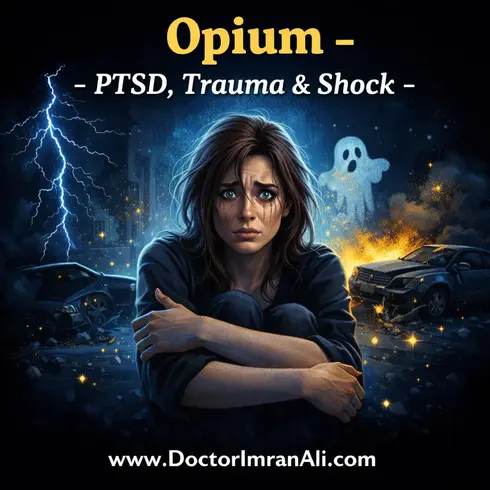
What Is Opium
What Are Opiates & Opioids
Opium, along with codeine and morphine, is classified as opiates (derived directly from the opium poppy). They are natural derivatives of the Opium poppy. Heroin is a semi-synthetic opioid derived from morphine. There’s a longer list of synthetic pharmaceutical opioids. These opioids include oxycodone, fentanyl, methadone, and others.
What Are Narcotics
Both classes of drugs, naturally occurring opiates and synthetic opioids, are considered narcotics. Narcotic is a term that means numbness-inducing or sleep-inducing. To varying degrees, narcotic drugs can dull the senses, relieve pain, and induce sedation. This is why most narcotics are used primarily as painkillers.
Common Uses of Crude Opium
Mind-Aletering Recreational Substance
Opium has a long history as a mind-altering recreational substance that notoriously induces a sleepy, dreamy state of bliss and euphoria.
Slows Down Physiological Functions
It also has the ability to slow down certain physiological functions. This is why Opium was commonly used in the 1800s as a cough suppressant drug. It depresses respiratory activity and blunts the cough reflex.
Chronic Diarrhea Drug
For the same reason, tincture of Opium is still used today as a treatment for chronic diarrhea. It slows down the digestive processes.
Abuse of Crude Opium is Extremely Dangerous to Health
Needless to say, this class of drugs is extremely dangerous to use. Opioid abuse has led to hundreds of thousands of deaths in the U.S. Homeopathic Opium, however, comes with practically zero safety concerns, and its therapeutic value is priceless.
Effects of Crude Opium Depend Upon the Dose Used
I want to begin by drawing a diagram that illustrates the spectrum of effects that crude Opium can have, depending upon the dose administered. This point here in the middle represents the everyday normal waking state.
- Small doses of crude Opium are capable of producing an initial phase of stimulation.
- This is followed by a heightening of the senses and a euphoric rush of exhilaration.
- However, with stronger doses of crude opium, the initial euphoric effect is only temporary.
- It quickly gives way to a more sustained phase of mental and physiological depression.
- This stage is characterized by relaxation, mental confusion, sleepiness, and finally loss of consciousness.
How Homeopathic Opium Acts on the Body & Mind
Now we can also use this diagram as an indicator for the therapeutic range of homeopathic Opium. Homeopathic Opium fits altered states of consciousness that span all the way from alert, excited, and hyperstimulated to confused, sleepy, or unconscious.
Ailments From Fright, Shock & Trauma
Just like aconite and arnica, opium is primarily a remedy for ailments from fright, shock, and trauma. Opium fits the effects of both physical and or emotional trauma. It’s a remedy for severe trauma. It’s a remedy for cases where the effects of trauma have become chronic, remaining long after the original triggering event.
This can apply to physical events like car accidents, head injuries, drug overdoses, and strokes. It can apply to psychological events like severe abuse, rape, witnessing an accident, or witnessing an act of violence. Regardless of the specific nature of the trauma Opium is indicated when the shock or fright induced by the traumatic event never fully wears off.
Opium is prominently listed in repertories under:
- Ailments from fright.
- Ailments from accidents and injuries.
- Ailments from shock.
- Ailments from excitement
- Ailments from embarrassment
- Ailments from mortification
- Ailments from shame.
We think of Opium when these emotional experiences have been particularly dramatic or severe.
When Original Fright Remains in the Mind
Opium is the main remedy indicated when the image of the original fright remains in the mind of the traumatized person long after the event has occurred. This can take the form of flashbacks to the original trauma.
When a trauma unexpectedly and involuntarily replays in the mind like a movie, Opium is our first choice of remedy.
Useful in PTSD
Of course, this is one of the hallmark features of PTSD or post traumatic stress disorder. Although not all Opium cases involve some clearly identifiable trauma, the bottom line is that we think of Opium whenever an intense traumatic experience has had a long-term negative impact on someone.
Spectrum of Opium Pathology
Now let’s return to our spectrum of Opium pathology. Opium’s response to these traumas can manifest in either direction along the spectrum, not unlike a fight-or-flight reaction.
Direction-1: Overexcited State
On the one hand, the senses can become intensified, and the person may become overexcited, easily alarmed, and may have difficulty sleeping.
Direction-2: Lack of Reaction
On the other hand, there can be dullness of thinking, drowsiness, confusion, and a lack of normal reaction to emotional and or physical stimuli.
In essence, the reaction to trauma can be one of over-excitement, or it can manifest as a strange lack of reaction. Sometimes the two states alternate with each other.
Understanding Both States of Opium in Detail
Let’s examine these two Opium states in more detail while keeping in mind that they are both potential responses to severe fright or trauma.
On the over-excitement end of the spectrum Opium symptomatology can resemble Nux Vomica. The mind tends to be sharp, clear, alert, and busy. The person may be hurried, intense, and impatient. The state of mind is compatible with workaholic behavior.
As it intensifies, it can spill over into an overstimulated state of excitement, manic exhilaration, or euphoria. Think of it as a subconscious coping mechanism.
The person springs into action and keeps busy to avoid thinking about or dealing with the underlying trauma, which, as we shall see, is often blocked from conscious awareness. This state of excitement can also manifest as anxiety, nervousness, fear, and even alarm.
Opium Is A Remedy for Fright
While Opium is one of the main remedies for fright, it’s interesting to note that it’s not listed in the repertory for many specific fears like fear of dogs or fear of cats. But it is one of the main remedies to think of for those who have been badly frightened in ways that have profoundly altered their lives.
Detached or Less Conscious State of Opium
A good way to describe the other end of the Opium spectrum is that patients become less conscious or less aware of themselves and of physical reality. Good words to describe this Opium state are detached and dissociated.
The senses are dulled, and the person may complain of feeling numb. Think of that classic scenario where an injured person is found walking around at the scene of an accident. His leg is broken, but he feels no pain because he’s in a state of shock.
This is represented in repertories under:
- Says he is well when he is very sick.
The two main remedies listed here are arnica and Opium.
Why the Opium Patient Feels No Pain In Case of Trauma?
In such cases, the response to trauma is to withdraw from the physical plane. To begin to leave one’s body, so to speak. In esoteric terms, one could say that the frightened individual retreats at least partially from the material plane onto the ethereal plane.
It’s in this state on the ethereal plane that a person tends to have surreal experiences, like being out of one’s body. Or as if floating in the air or seeing oneself across the room. Opium is the main remedy for out-of-body experiences.
It’s listed in the repertory under:
- Delusion floating in the air
Numbness And Painlessness of the Opium Person
Another characteristic of this detached Opium state is numbness and painlessness. Withdrawing from the material plane results in a decreased ability to experience physical sensation. And that’s exactly why, when faced with trauma, the vital force may retreat into an Opium state. It seeks to protect itself from intense pain and suffering.
The repertory lists this phenomenon under:
- Painlessness of complaints that are usually painful.
If I suspect Opium while taking a case, I will ask the person about their pain tolerance. Opium typically has a higher pain threshold than most.
Opium’s Mental State of Numbness
The Opium state of mind can also be one of numbness. He feels nothing asks for nothing and complains about nothing. This is explained by the idea that on the ethereal plane, a person can feel unusually calm, placid, at peace, even blissful.
Opium is listed prominently under:
- Lack of reaction to remedies
In other words, when well-chosen remedies that appear to fit the case fail to work, we think of a remedy like Opium.
Moral Numbness of Opium
In some cases, this numbness or lack of reaction can also apply to the moral character of a person. There may be a lack of moral conscience or a diminished sense of right and wrong, with a tendency to be untruthful.
Opium lists in repertories under:
- Liar
- Inclination to tell lies
Physiological State of Opium
Now, on a physiological level, the Opium state is one that involves an overall slowing down of the bodily functions.
- Everything comes to a halt, and you momentarily stop breathing.
- Reality became distorted as if it were happening in a dream.
- Consciousness becomes distorted.
- There can be mental confusion, drowsiness, or sleepiness.
- Opium fits people who fall asleep easily or who sleep very heavily.
- It’s one of the main remedies for narcolepsy.
- People who need Opium tend to dream frequently and dream heavily.
- Opium lists prominently in the repertory under: As if in a dream.
- At the far end of the spectrum, complete loss of consciousness can occur.
- Opium is one of the main remedies for any illness that is accompanied by loss of consciousness.
- Whenever there’s a history of concussion [2] or head injury during which the person even briefly loses consciousness, we must think of Opium.
Opium’s Most Important Physical Pathologies
Constipation With No Urge to Stool
Opium and synthetic opioids are famous for their tendency to cause constipation. Homeopathic Opium is a remedy for severe constipation, especially when the urge to stool is absent.
If stool is passed, it tends to be in the form of hard, round black balls. This kind of severe constipation is commonly accompanied by bloating, abdominal pain, and even vomiting.
Useful In Cases of Inhibited Respiration & Sleep Apnea
Opium also has a tendency to slow down or to inhibit respiration. This is why it can be a great remedy in cases of sleep apnea [3]. Such persons may abruptly wake from sleep with a feeling of suffocation. Opium resolved the problem almost immediately.
Generals And Modalities Of Opium
Warm Blooded
Opium is usually warm-blooded and tends to be aggravated by warmth or heat.
The bed feels very hot
Sometimes the bed can feel too hot.
Flushing of Face
There may be flushing of the face and or hot, sweaty skin.
Aggravation Factors
Opium can be aggravated by:
- Fright
- Fear
- Anger
- Shame.
- During or after sleep
- Alcohol.
Remedy Relationships Of Opium
Complements to Opium include:
- Alumina
- Berberis
- Bryonia
- Phosphorus
- Plumbum Met
Remedies to compare to Opium include:
- Aconite
- Arnica
- Nux vomica
- Alumina
- Helleborus
- Belladonna
Seek Personalized Homeopathic Support Today
Struggling with trauma, stress, or physical symptoms related to fright or shock? Get expert guidance from a certified homeopath. Start your online consultation now and find a safe, natural path to healing with remedies like Opium.
[Book Your Online Consultation]
Glossary
Stroke
A stroke is an emergency where brain blood flow stops (ischemic) or bleeding occurs in the brain (hemorrhagic), causing fast brain cell death.
PTSD
Post-Traumatic Stress Disorder (PTSD) is a mental disorder that develops after experiencing or seeing a traumatic event like war, abuse, or disasters.
Fight or Flight State
The fight-or-flight response is an automatic survival reaction to danger. It activates the sympathetic nervous system, causing a fast heartbeat, quick breathing, muscle tightness, and adrenaline release to help you fight or escape.
Euphoria
Euphoria is a strong feeling of intense happiness, excitement, or well-being. It can occur naturally or due to certain experiences, substances, or medical conditions.
Etherial Plane
The ethereal (etherial) plane refers to a non-physical or spiritual realm—energy, spirit, or subtle existence beyond the physical world.
Narcolepsy
Narcolepsy is a long-term brain disorder that disrupts the sleep–wake cycle, causing severe daytime sleepiness, sudden sleep attacks, and sometimes muscle weakness (cataplexy).
References
- Opium poppy – Encyclopaedia Britannica (Papaver somniferum, source of opium and opioids)
- Concussion – Encyclopaedia Britannica (temporary brain injury from force to the head)
- Sleep apnea – Encyclopaedia Britannica (breathing pauses during sleep)

Homeopathic Dr. Imran Ali, DHMS, BHMS (Gold Medalist, University of Peshawar), RHMP, is a qualified homeopathic physician with over 10 years of clinical experience. He is registered with NCH (Reg. No. 170600) and focuses on safe, individualized, and holistic homeopathic care. Author of the Kindle book “Homeopathy For Infants & Kids – Curing 165 Most Common Issues” – available on Amazon.