Pulsatilla Nigricans – The Windflower Remedy
Hi, I’m Dr. Imran Ali, and welcome back to the Homeopathic Materia Medica Series. Today I’ll be talking about Pulsatilla Nigricans, the Windflower. It’s amazing how this delicate little purple flower can be such an amazing healing agent in so many different situations.
Much can be said about Pulsatilla, but I’ll continue to try my best to condense the information in these videos so that they don’t run too long. So let’s jump right in.
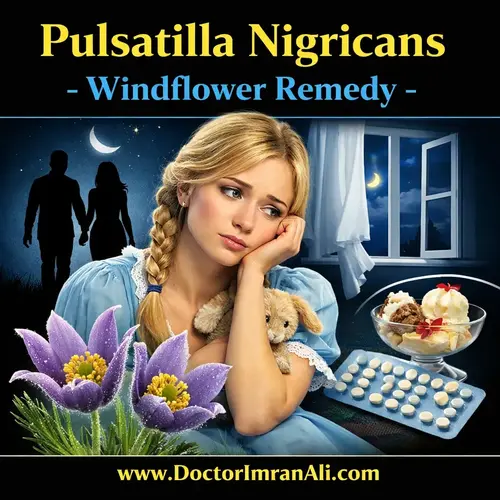
Psychological Profile of Pulsatilla Nigricans
Pulsatilla is a Feminine Remedy (Soft, Mild, Shy, Loving)
Let’s begin with the Pulsatilla psychological profile. If Nux Vomica is the remedy that represents the archetypal masculine, then Pulsatilla represents the archetype of femininity. Pulsatilla type is soft, sweet, and feminine. She is gentle and mild and kind and loving. Although sometimes shy or timid, she is nevertheless emotionally open. She willingly shares her feelings in a way that tends to draw out the sympathies of others.
Pulsatilla Seeks Sympathy & Attention From Others
In fact, she seeks attention and sympathy from others. She desires consolation and wants to be reassured and comforted. Pulsatilla seeks both emotional support and physical attention. We can spot the little Pulsatilla girl because she likes to wear dresses, and she clings to her mother. She wants to sit in Mom’s lap and be carried around.
Likes to Receive Hugs, Love & Attention
And the Pulsatilla adult loves to receive hugs. Her demeanor can sometimes come across as naive or childlike. She is openly affectionate and loves to give hugs as much as she likes to get hugs. She craves love and attention.
Changeable States of Emotion
Another key characteristic of Pulsatilla is that she is prone to changeable states of emotion. She may be happy one moment, sad and weepy the next, and irritable the next. As we shall see, this changeability is a theme that runs through Pulsatilla symptomatology.
Pulsatilla is Agreeable & a people pleaser
Now, Pulsatilla is also famously agreeable. She tends to go along with what others want. Like a flower, she drifts wherever the wind blows her. She’s a follower because she is a people pleaser. She often yields to the opinions, beliefs, and desires of those around her.
Pulsatilla is Submissive
As such, she can be submissive (obeys others) and acquiescent (accepts others’ wishes). She accepts others as they are in a kind, sympathetic, loving manner. This trait can be so strong that she can wind up not knowing what it is that she really wants. She doesn’t have strong opinions or strong beliefs.
Indecisive & Dependent upon Others
This makes her indecisive (compare Anacardium) because she doesn’t really know what she herself thinks. Instead, she looks to others for guidance and reassurance when it comes to making decisions. Of course, the downside of this is that she can be taken advantage of quite easily. She’s easily swayed and influenced and may become overly dependent upon others.
Pulsatilla Desires & Needs Company
Knowing all this, it’s easy to see why Pulsatilla needs company (compare Phosphorus). She’s not inclined to live alone. In fact, this need for companionship makes it likely that when she experiences a romantic breakup, she will quickly jump into another relationship. Of course, she often does this for the wrong reason, which is to avoid being alone.
She is a Nurturer & Has Mothering Instinct
On the positive side, Pulsatilla types are natural-born nurturers. Pulsatilla has a highly developed mothering instinct. She lives for family, and she lives for her children. Perhaps one of the worst fates for a Pulsatilla woman is to be unable to bear children.
Pulsatilla Weeps Easily & Gently
Another keynote symptom is that Pulsatilla tends to weep easily. This shouldn’t be confused with the dramatic, hysterical cries of Ignatia. Pulsatilla is teary. She weeps gently and softly, drawing out the sympathy of those around her. She cries at the drop of a hat, especially when talking about her problems.
Depression of Pulsatilla Nigricans
When Pulsatilla presents with depression, she may refer to it as sadness. She tends to project an I’m sad, woe is me, please help me type of feeling. The source of her sadness and depression can often be tracked to a feeling of having been abandoned. She experiences loss as being forsaken, as being left alone and unloved.
Pulsatilla is listed prominently in repertories under:
- Forsaken feeling
- Delusion that she is alone.
Fear of Being Alone
It makes sense, therefore, that one of Pulsatilla’s biggest fears is the fear of being alone (compare Arsenicum Album). She desires company, craves sympathy, and fears being left alone. The Pulsatilla child doesn’t venture too far off on her own. She stays nearby, close to her parents.
More Fears of Pulsatilla
Additional Pulsatilla fears include:
- Fear of heights (compare Argenticum Nitricum)
- Fear of the dark
- Fear of crowds
- Claustrophobia.
When Pulsatilla Becomes A Rigid or Dogmatic Person
Now, with all that said, in some cases, Pulsatilla can become rigid or dogmatic. In such cases, although she may come across as sure deep down, she still doesn’t know what she really believes. That apparent certainty turns out to be a subconscious coping mechanism. One that compensates for her underlying lack of conviction.
She desperately clings to a person, an idea, or a belief system that she thinks will give her the answers that she needs. This can sometimes take the form of rigid political or religious beliefs. She may even embrace religious fundamentalism.
How to Spot a Male Puslatilla?
And finally, it’s worth noting that just like with Nux, which can be helpful for women’s health problems, Pulsatilla can also be of great help in men’s health problems. I have successfully prescribed it many times for men, both acutely and constitutionally. When we see a gentle, easygoing man who has a strong attachment to his family and especially to his children, we must think of Pulsatilla.
General Physical Characteristics of Pulsatilla Nigricans
Okay, now let’s talk about the Pulsatilla Generals.
Physical Appearance of Pulsatilla
In terms of physical appearance, many Pulsatilla constitutional types have blonde hair, blue eyes, and a shapely, feminine figure. Now, not all people who need Pulsatilla look like this, but when we encounter these physical features, we should think of Pulsatilla.
Pulsatilla is Warm-Blooded
Now, generally speaking, Pulsatilla is warm-blooded and is bothered by too much heat. She does not like to sleep in a warm room.
Sleep on Her Back & Keep Feet Uncovered
She tends to keep her feet uncovered in bed and may sleep on her back.
Loves Fresh, Open Air
Pulsatilla is usually an outdoor person. She loves fresh open air and feels better outside in the cool air. She often prefers to keep the windows open.
Pulsatilla Symptoms Are Changeable
An important generality is that Pulsatilla symptoms are notoriously changeable. As noted previously, this applies to her emotional states, but it’s also characteristic of her physical symptoms, too. If you find yourself confused because there’s no clear symptom pattern, the pattern being expressed may be one of changeability.
Loves Creamy Foods
In terms of food interests, Pulsatilla is famous for its love of creamy foods. She gravitates towards things like:
- Peanut butter,
- Mac and cheese,
- Butter ice cream,
- Cheesecake,
- Creamy cheese soups,
- Creamy sauces.
Creamy Foods Upset Her Digestion Too
Although she likes these kinds of food,s they often disagree with her and can upset her digestion. In fact, she can be averse to or aggravated by the same rich, creamy fatty foods that she loves and craves.
Relationship to Eggs
She has a similar relationship to eggs, which she may desire or be averse to, or which may aggravate her symptoms.
Prefers Cold Foods
Pulsatilla prefers cold foods and may dislike warm foods or warm drinks.
Pulsatilla is Thirstless
And last but not least, Pulsatilla is famous for its lack of thirst. She tends to be thirstless. This often becomes clear, especially during acute illnesses, like during a fever, for example, where you would expect her to be thirsty, but she isn’t. But she may lack thirst even when she’s not sick.
In order to ascertain whether a patient is thirstless, I will often ask if she needs to remind herself to drink fluids. Many Pulsatilla patients will admit to this telltale keynote clue.
Physical Health Problems of Pulsatilla
All right now, let’s talk about some of Pulsatilla’s physical health problems.
Pulsatilla For Menstrual Problems
Pulsatilla, being the feminine remedy that it is, is well-suited to a variety of women’s health issues. It can be useful for the entire range of menstrual irregularities, including:
- Painful menses,
- Absence of menses,
- Suppressed menses,
- And, of course, the telltale irregular, changeable menstrual cycles.
Headache at the close of Menses
One specific clue is that Pulsatilla is indicated for headaches that occur at the close of the menses when the flow stops.
Leuchorrea
It’s a commonly indicated remedy for leucorrhea, which is medical lingo for a vaginal discharge. The leucorrhea may be chronic, or it may be a sign of infection. The discharge is often bland and changeable in quality, sometimes yellow, sometimes green, and so on.
Pulsatilla For Problems During Pregnancy
Of course, Pulsatilla is an important remedy for problems during pregnancy.
Incontinence of Urine During Pregnancy
There may be incontinence of urine during pregnancy.
Malposition of the Fetus
Pulsatilla is famously indicated for malposition of the fetus near the end of pregnancy. It’s been known to save the day in breech presentations when labor is approaching.
Pulsatilla is a remedy for women who feel better when pregnant
Occasionally, I’ve met women who claim that they feel better when pregnant and that their symptoms improve dramatically during pregnancy. I’ve had more than one person tell me I felt the best I ever felt in my life during my pregnancies. In such cases, Pulsatilla is surely the remedy of choice.
Menopausal Problems
And finally, Pulsatilla is a remedy for menopausal problems and hot flashes. Whenever we see the corresponding mentals and generals associated with these female health conditions, we must think of Pulsatilla.
Digestive Problems of Pulsatilla
Now, Pulsatilla also tends to be helpful for a variety of digestive problems. In most cases, those problems are aggravated by eating rich fatty foods. Whether it’s heartburn, indigestion, or diarrhea, they are likely to be aggravated by rich foods, especially ice cream.
A Case of Gallbladder Attack Cured By Pulsatilla
I recall a case of an adult male who was having painful gallbladder attacks. After discovering that he was also craving peanut butter at the same time, I prescribed a few doses of Pulsatill, which brought his attacks to an abrupt end.
Nausea From Rich Foods or During Pregnancy
Nausea is another important clue that often points to Pulsatilla. Especially when we see nausea from rich food or nausea during pregnancy. Of course, many remedies fit nausea, but three constitutional remedies commonly have nausea as a prominent feature. They are Pulsatilla, Sepia, and Nux vomica.
When we see nausea in the context of female hormonal problems, we think Pulsatilla or Sepia. When nausea accompanies chronic digestive problems, we think Pulsatilla or Nux Vomica.
Modalities of Pulsatilla Nigricans
Now, let’s review the modalities associated with Pulsatilla.
Aggravation from Heat
Generally speaking, we have aggravation from heat and amelioration from cold. Pulsatilla is aggravated by too much warmth. She dislikes a warm, stuffy room with no circulating air. She can be aggravated by the heat of the sun.
Better in Fresh, Open, Cool Air
Conversely, Pulsatilla feels better in cold or cool air. Fresh cool open air ameliorates her symptoms. Even if she happens to be chilly, she may still prefer the open air.
Likes to Walk Slowly in Fresh Air
She likes to walk slowly outside in the fresh air.
Pulsatilla Feels Better From Slow Gentle Motion
This illustrates another modality, which is that she feels better from slow, gentle motion.
Cold Applications Ameliorate
She also prefers cold application,s which may bring relief, for example, to arthritic pains.
Pulsatilla Symptoms in Arthritis
Remember the changeable nature of Pulsatilla symptoms. When we see wandering arthritis that moves from location to location, and it feels worse from heat and better from walking slowly and better from cold applications, we think of Pulsatilla.
Aggravated by Rich Fatty Foods
As we’ve already seen, Pulsatilla is aggravated by rich fatty foods.
Aggravated By Hormonal Changes
And lastly, Pulsatilla problems can be aggravated by any hormonal event or hormonal change, such as:
- At puberty
- Around the menses
- During pregnancy
- At menopause
- From birth control pills.
Pulsatilla for Acute Ailments
Now let’s talk about Pulsatilla for acute ailments. I can’t emphasize enough how commonly indicated this remedy is for a wide variety of acute conditions.
Pulsatilla has been successfully used to treat the following:
- Common cold
- Ear infections
- Coughs
- And other respiratory infections.
Measles, Chickenpox, Mumps
- It’s invaluable in the treatment of measles, chickenpox, and mumps.
Genitourinary Problems
It can be useful in genitourinary problems such as:
- Bladder infections
- Vaginitis [1]
- Orchitis
- Prostatitis [2]
- Epididymitis.
Orchitis After Chronic Mumps
In fact, it’s almost as specific for a particular sequela of mumps that metastasizes to the testicles, resulting in orchitis.
Conjunctivitis, Styes on Upper Eyelids
It can be helpful in cases of conjunctivitis and even for styes [3], especially when the styes are located on the upper eyelids.
Pulsatilla Cough Symptoms
The classic Pulsatilla cough is one that is dry in the evening, loose in the morning, and forces the patient to sit up because it’s worse when lying in bed at night.
Keynote Clues In Acute Conditions Indicating Pulsatilla
When any of these conditions are accompanied by the following keynote clues associated with this remedy, we must consider Pulsatilla:
- Thirstlessness
- Warm-bloodedness
- Amelioration from the open air
- Changeable symptoms
- Desire for company and sympathy
Remedy Relationships
Let’s finish now with remedy relationships.
Silicea (Complementary Remedy)
Pulsatilla is known to have a complementary relationship to Silica.
Kali Sulph (Irritable Pulsatilla)
And when we’re thinking about Pulsatilla, we must compare it to similar remedies, such as Kali sulph, which is known as the irritable Pulsatilla and shares many of its characteristics.
Sepia (Female Hormones)
It’s also important to compare Pulsatilla to Sepia because both have a broad impact on the female hormonal system.
Need An Online Homeopathic Consultation?
Do you have Gentle emotional sensitivity, changeable moods, hormonal imbalance, digestive troubles? Get a personalized online homeopathic consultation based on your mental picture, modalities, and physical symptoms. Begin natural, individualized healing today.
Glossary
Claustrophobia
Claustrophobia is an anxiety disorder marked by an intense, irrational fear of confined spaces, causing severe distress, panic attacks, and symptoms like sweating, trembling, and rapid heartbeat, often triggered by places such as elevators or tunnels.
Breech Presentations
Breech presentation is when the baby lies with the feet or buttocks facing downward instead of the head, seen in about 3–4% of term pregnancies.
Gallbladder Attack
A gallbladder attack, or biliary colic, is a sudden, sharp pain in the upper right abdomen due to gallstones obstructing bile ducts, often occurring after fatty foods and lasting 1–5 hours.
Epididymitis
Epididymitis is inflammation of the epididymis behind the testicle, leading to pain, swelling, and redness, usually caused by bacterial infections such as STIs or UTIs.
References
- Vaginitis: WHO Standard Treatment Guidelines
- Prostatitis: WHO STI Management Guidelines
- Stye (Hordeolum): NCBI / NIH – InformedHealth

Homeopathic Dr. Imran Ali, DHMS, BHMS (Gold Medalist, University of Peshawar), RHMP, is a qualified homeopathic physician with over 10 years of clinical experience. He is registered with NCH (Reg. No. 170600) and focuses on safe, individualized, and holistic homeopathic care. Author of the Kindle book “Homeopathy For Infants & Kids – Curing 165 Most Common Issues” – available on Amazon.