Stramonium: A Remedy for Extreme Psychiatric Pathology
Hi. I’m Dr. Imran Ali. Welcome to the new post of the Homeopathic Materia Medica series. In this episode, I have chosen to discuss Stramonium mainly because it’s such a valuable and commonly indicated remedy. I’ve seen it work so well for so many patients. It’s an indispensable remedy.
Materia medica can be a tricky thing. Sometimes we can get very different impressions of the same remedy from studying different sources. Some of the older materia medica can make one think that Stramonium is suited only for extreme psychiatric pathology.
Listen to this brief description of the mental symptoms from one source:
“Stramonium does all sorts of crazy things, raving mania and cold sweat, religious insanities, self-accusation, talks in a foreign tongue, fear and anxiety on hearing water run, aversion to all fluids, mania, curses, tears his clothes with teeth, violent speech, exposes himself, wants to kill people or himself.”
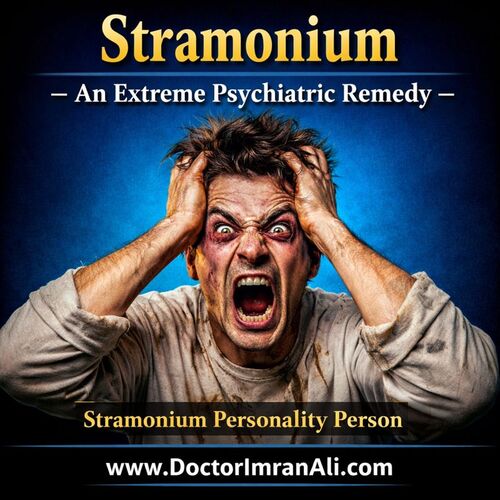
Stramonium Is Also Suited For Acute and Everyday Cases
Now, it’s true that Stramonium could work miracles when properly prescribed by a qualified homeopath in a psychic setting. But it’s important to understand that Stramonium can also be very helpful in garden-variety, run-of-the-mill cases. Like:
- A kid who’s afraid of the dark,
- A young girl who refuses to learn how to swim,
- A little boy who has a habit of biting his sister.
Stramonium is an everyday remedy that can be successfully used in everyday cases. In the following presentation, I’ll summarize some of the more common keynotes, symptoms, and characteristics of homeopathic Stramonium.
Nomenclature and History of Stramonium
Stramonium is also known as the common thorn apple. The scientific name is Datura Stramonium, which is the genus and species of the plant. In the days of the early settlers of America, it was known as Jamestown weed, and it later came to be known as Jimsonweed.
Some People Smoke Jimsonweedd to Get a Cheap High
There have been periodic reports over the years of kids trying to smoke Jimsonweed to get a cheap high. As we discussed the pathology of this plant and this remedy, it’ll become clear that this is the last thing you want to try to get a cheap high from. The plant is from the nightshade family, the Solanaceae family.
Doctrine of Signatures: Flowers Open and Bloom at Night While Closed During the Day
The interesting thing about it is that the flowers open up at night, close during the day, and bloom again at night. This is a metaphor for the action of the substance of the plant and some of the pathology associated with it. It’s part of what you could consider the doctrine of signatures, whereby the form is an indication of the function of the plant.
Key Theme of Stramonium is Fear and Aggression
There is a very strong theme that runs throughout Stramonium, and that is fear and aggression. Oftentimes, in cases, we’ll see both fear and aggression being expressed in the person who needs this remedy. Sometimes we’ll see one or the other, where you can have mostly just fear or mostly just aggression. A lot of times, there’s fear and violence combined. The fear part tends to be the stronger, more common feature that will lead you to a prescription of Stramonium.
Level of Fear is Dramatic & Striking in Stramonium
In most Stramonium cases, the level of fear is often dramatic and striking. The most prominent and common fears tend to be:
- Fear of the dark,
- Fear of being alone,
- Fear of violence,
- Fear of animals,
- Fear of water.
Fear of the Dark is Especially Prominent in Stramonium
Fear of the dark is especially prominent and often occurs when the person is alone in the dark at night. You’ll see this often with children, where there are elaborate bedtime rituals.
- Parents do everything they can to get their child to sleep, such as leaving a nightlight in the room or lying down with the child.
- Even then, oftentimes, a child will wake up in the middle of the night and run to the parents’ room.
- Some kids won’t sleep alone in their own room at all.
- Sometimes they will sleep if they have a sibling in the room and a nightlight.
- A lot of times, they just won’t tolerate being alone or away from their parents at night.
Fear of Violence in All Shapes
There is also fear of violence in all shapes and forms:
- Fear of any kind of danger,
- Fear of being attacked,
- Fear of being murdered or injured,
- Fear of a violent death.
- Adults who are afraid of terrorists.
- Children are often afraid of scary TV shows and movies, as are adults, too.
- Kids can sometimes be afraid of clowns or Halloween costumes.
Many children who need Stramonium can have nightmares and night terrors.
Fear of Animals is Common in Stramonium
Fear of animals is common, especially dogs, but also any potentially aggressive or dangerous animal, like bears or wolves. You’d be surprised if you ask a two-year-old or three-year-old what they’re afraid of, and they’ll say things like dinosaurs, sharks, or “animals with big teeth.” Parents sometimes dismiss these fears as just a vivid imagination, but the things kids say are not coincidental and are often very useful clues.
Fascinated with Violence but Also Afraid of it
Sometimes you’ll see people who are fascinated with violence but also afraid of it. Teenagers may admit they’re into horror movies but are also terrified.
All these fears demonstrate the importance of limiting children’s exposure to violence.
Young minds are impressionable and can be easily scared. Children often cannot differentiate between fantasy violence and reality.
Fear of Water
Fear of water often appears in children as an aversion to getting water on their head, such as when bathing or swimming. Adults who are afraid to swim or have never learned to swim may also be exhibiting this fear.
Fear of Tunnels & Claustrophobia
Fear of tunnels and claustrophobia are related, as all these fears involve the fear of suffocation as a method of death.
5 Main Fears of Stramonium
In summary, the main fears associated with Stramonium are:
- Fear of the dark
- Fear of being alone
- Fear of violence
- Fear of animals
- Fear of water
Aggression is The Second Most Important Theme of Stramonium
On the flip side, Stramonium often presents with aggression. There is intensity, impulsivity, and excitability, often to the point of violence. The person may be explosive, with sudden outbursts of anger or rage. Stramonium reacts almost involuntarily, unlike a tuberculoid child, whose tantrums are acts of will.
There may be:
- Screaming,
- Shrieking,
- Threats,
- Hitting,
- Biting,
- Striking,
- Swearing.
Sometimes this aggression is directed inward, leading to suicidal behavior. Occasionally, there may be no aggression at all, and the person may appear timid or introverted, expressing the fearful side. Rarely, someone is well-balanced; more often, a mix of timid and aggressive traits is present.
Hyperactivity of Stramonium
Another common feature of Stramonium is hyperactivity. Patients can be restless, overly active, and agitated.
ADHD
Children may be loud, wild, and loquacious(very talkative). Many come to the homeopath with a diagnosis of ADHD(Attention-deficit/hyperactivity disorder).
PTSD Cases
PTSD(Post-traumatic stress disorder) cases, especially those involving exposure to violence, respond well to Stramonium.
Fight-or-Flight State
The underlying state is one of fight-or-flight, as if the original threat is still present. Patients are hyper-vigilant, ready to fight or flee at any moment.
Additional Psychiatric and Neurologic Indications of Stramonium
Stramonium is a common remedy for young boys, but is also indicated for girls.
Psychiatric Disorders
It can be indicated in psychiatric disorders, including:
- OCD (Obsessive Compulsive Disorder) [1]
- Mania
- Paranoia
- Schizophrenia [2]
Neurologic Problems
It is associated with neurologic problems such as:
- Stuttering (Stammering) [3]
- Tics
- Involuntary movements like head jerking, eye blinking,
- Chorea
- Tourette’s syndrome [4]
- Stramonium can help with strabismus, where the eye muscles misalign, causing a cross-eyed appearance or double vision.
- Muscle twitches,
- Spasms,
- Febrile seizures (Convulsions due to high fever)
- Seizure disorders
Physical Symptoms & Modalities of Stramonium
Physical clues include:
- Red or pink face,
- Dilated pupils,
- Twitching,
Common Conditions
These symptoms are often seen in:
- Fevers
- Seizures
- Mania
- Sunstroke
Meningitis & Rabies
Stramonium may be helpful in meningitis(inflammation of the brain membranes) and even rabies [5].
Most prescription clues are psychological and behavioral, but some physical signs can support the remedy.
Worse at Night or Dark
Symptoms are often worse at night or in the dark and improve in the light.
Causes of Physical Ailments
Etiology often involves:
- Frightening events,
- Abuse,
- Neurologic insults like fever or trauma.
Warm-Blooded & Desires Sweets
Patients tend to be warm-blooded and may desire sweets.
Pink Tinge to Entire Face
Some cases show a pink tinge to the entire face.
Left Hip Pain
Left hip pain may also be a specific symptom of Stramonium.
Ear Infections, Headaches, Coughs, Asthma
If the rest of the case fits, Stramonium can address various physical problems, such as:
- Ear infections,
- Headaches,
- Coughs,
- Asthma.
Comparative Study of Stramonium With Other Remedies
Hyoscyamus (Rage & Fears)
Important remedies to compare include Hyoscyamus, which can have rage and similar fears, but the underlying state is jealousy or a desire for attention.
Belladonna (Fears, Explosive)
Belladonna has similar fears and can be explosive, but it’s usually not fear-based.
Aconite & Opium
Study and compare Aconite and Opium with Stramonium for further understanding.
Get Your Online Homeopathic Consultation Today
Consult with a qualified homeopath from the comfort of your home. Submit your case, pay the consultation fee securely, and receive personalized homeopathic guidance tailored just for you.
Glossary
OCD
Obsessive-Compulsive Disorder (OCD) is a mental condition marked by intrusive thoughts and repetitive behaviors done to relieve anxiety, disrupting daily life. Common obsessions involve fears of contamination, harm, or intrusive images, while compulsions include excessive washing, checking, counting, ordering, or reassurance-seeking, offering only brief relief and often consuming over an hour each day.
Stammering
Stuttering (also called stammering) is a speech disorder that interrupts the normal flow of speech, causing repetitions of sounds, syllables, or words, prolongations, or brief blocks of silence, in which the person knows what they want to say but has difficulty expressing it smoothly.
Tics
Sudden, involuntary, repetitive movements or sounds, commonly appearing in childhood
Chorea
A hyperkinetic movement disorder marked by involuntary, irregular, unpredictable, and rapid movements that appear “dance-like,” commonly involving the limbs, face, and trunk.
Hyperkinetic
Refers to conditions involving excessive or abnormal involuntary movements.
Tourette syndrome (TS)
Tourette syndrome (TS) is a neurological condition that usually begins between the ages of 2 and 15 and is marked by involuntary, repetitive movements and sounds known as tics, such as blinking, shoulder shrugging, or throat clearing.
Meningitis
Meningitis is a serious and potentially life-threatening inflammation of the protective membranes (meninges) around the brain and spinal cord, most often caused by bacteria, viruses, fungi, or parasites. Common symptoms include high fever, neck stiffness, severe headache, confusion, and vomiting. Bacterial meningitis is a medical emergency and requires urgent treatment with antibiotics and steroids.
Rabies
Rabies is a nearly always fatal but vaccine-preventable viral disease causing acute encephalitis, spread through the saliva of infected animals, usually dogs, via bites, scratches, or mucous contact; symptoms include fever, tingling at the bite site, aggression, hydrophobia, and paralysis, and survival depends on immediate post-exposure prophylaxis (PEP).
Post-exposure prophylaxis (PEP)
Post-exposure prophylaxis (PEP) is emergency short-term treatment to prevent HIV after possible exposure.
Paranoia
Paranoia is a mental state of irrational distrust or suspicion, often with delusions of persecution or conspiracy, arising from stress, brain chemistry imbalance, or mental disorders like schizophrenia or anxiety.
Schizophrenia
Schizophrenia is a chronic brain disorder affecting ~1% of people, usually starting in late teens or twenties, causing psychosis (hallucinations, delusions, disorganized speech) and negative symptoms like low emotion and motivation.
References
- Obsessive–Compulsive Disorder (OCD) – Wikipedia (overview with clinical info)
- Schizophrenia – World Health Organization (WHO)
- Stuttering – MedlinePlus (NIH/NLM)
- Tourette Syndrome – National Institute of Neurological Disorders and Stroke (NIH)
- Rabies Fact Sheet – World Health Organization (WHO)

Homeopathic Dr. Imran Ali, DHMS, BHMS (Gold Medalist, University of Peshawar), RHMP, is a qualified homeopathic physician with over 10 years of clinical experience. He is registered with NCH (Reg. No. 170600) and focuses on safe, individualized, and holistic homeopathic care. Author of the Kindle book “Homeopathy For Infants & Kids – Curing 165 Most Common Issues” – available on Amazon.