Sepia Officinalis Introduction
Welcome back to the Homeopathy Materia Medica series. Today, I’ll be talking about a commonly indicated and well-known remedy, one that is extremely valuable for its application to women’s health issues. Sepia Officinalis is a remedy made from the dark brown ink of the cuttlefish [1]. This little squid-like creature releases its ink into the water when in danger, creating a type of smoke screen behind which to hide or escape. As we shall see, this phenomenon has some interesting parallels reflected in the symptomatology of Sepia.
Alright, so let’s jump right in.
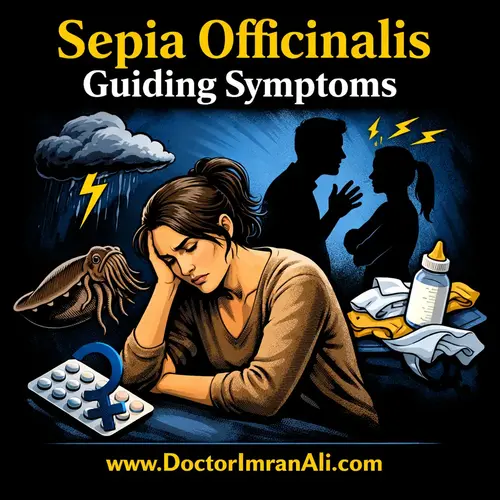
Sepia Officinalis Mental State
So let’s begin with the Sepia mentals. If I had to summarize Sepia’s state of mind, I would characterize it with the following.
- Apathy (indifferent)
- Irritability
- Hormonal dysfunction
- Aversion to relationships
The Sepia state is famously described in the homeopathic literature as indifferent.
Let’s take a closer look at the meaning of that word. To be indifferent means to be without interest, not caring one way or the other. A word similar to indifferent is apathetic. It’s a state of disinterested neutrality.

Cuttle Fish Releasing Ink – Sepia Remedy Made from this Ink
Sepia tends not to demonstrate the typical highs and lows of emotion that most people experience. She tends to have a flattened affect, which is best characterized as a lack of emotional range. Instead, Sepia just feels apathetic, indifferent. She often comes across as emotionally distant. She’s not necessarily depressed, but neither is she excited or happy. She’s just sort of blasé or blah for short.
She may complain that she feels unmotivated or that she doesn’t feel much at all. It’s easy to see how indifference and apathy can be precursors to a lack of motivation. Some need Sepia that can be described as being cold and detached. But it’s not so much a dark, black depression as much as it is a brown, blah hormonal depression.
While others around her may notice Sepia’s indifference, she may not be aware of it herself. Especially since it may have crept over her so gradually that it now seems to her like her normal state of mind. As we shall see, most of Sepia’s pathology is a product of hormonal dysfunction. And such hormonal changes often take place slowly over the course of months and even years.
Sepia and Her Problems in Personal Relationships Due to Hormonal Changes
Now Sepia’s problems tend to manifest most obviously in her personal relationships, especially family relationships. Sepia lists very prominently in the repertory under:
- Aversion to family,
- Indifference toward her children,
- Aversion to her husband.
Again, this lack of normal emotional feeling, this lack of familial love and affection, is a pathological state that can frequently be traced back to some kind of hormonal change in Sepia’s life.
As a consequence of this hormonal influence, she grows tired of her family, becomes irritated at her children, and is averse to the company of her husband.
Sepia Feels Family & Daily Tasks of Family As a Burden
To the Sepia family becomes mostly a burden and a chore. She dreads the thought of doing the laundry or of having to cook dinner. She dreads the hour when the children return home from school.
She loses her patience and snaps at her husband and screams at the kids when they squabble, make messes, or make noise. She becomes easily worn out and exhausted from domestic responsibility. She becomes increasingly intolerant of the very idea of housework or homemaking.
Now it’s usually not so obvious. Sepia isn’t going to present complaining that I can’t stand my kids or that I hate my husband. She may complain, however, that she can’t handle the stress at home or that she’s lost interest in being intimate with her husband.
Sepia Women Prefer to Become Working Woman
Many Sepia types seek to escape from the stress of domestic responsibility by entering the work world. They feel invigorated by work, and many choose to pursue a career. Sepia can look a lot like Nux in the sense that they can both fit ambitious stressed out career-oriented women.
Sepia Express No Interest in Getting Married & Having Children
We must consider Sepia whenever we encounter a woman who expresses no interest in getting married, having children, or raising a family. I have personally witnessed quite a few Sepia cases that consulted me for depression. And upon discussing their circumstances, I discovered that they were contemplating divorce as a solution for their unhappiness.
In such cases where I suspect that Sepia is needed, I usually urge the person not to make any rash decisions. And after taking Sepia, I’ve seen many of them completely change their attitude. Oftentimes declaring to me that they feel great about their marriage and are getting along just fine with their husbands.
Of course, sometimes divorce is legitimately warranted. But when Sepia gets divorced, she is likely to carry the same state of mind with her into the next relationship.
Misinterpretations of Sepia (Washerwoman’s Remedy?)
Now, people unfamiliar with Homeopathy can sometimes wrongly interpret this description of Sepia as a product of an old-fashioned, sexist worldview. Some descriptions in the old literature are indeed outdated, especially the one that characterizes Sepia as the worn-out washerwoman’s remedy. While this description is sexist by modern standards, the phenomenon itself is a very real one.
There are, in fact, many women who undergo hormonal changes who then lose their natural affection for family and then seek relief by attempting to escape from home and its responsibilities. Homeopathy can restore balance in health to such individuals. Thus making it possible for them to look forward to and to enjoy both work and family.
Furthermore, it’s important to understand that Sepia is predominantly but not exclusively a woman’s remedy. I’ve seen it work on occasion for men, too.
Emotional Sensitivities of Sepia
Great Tendency To Weep
Now, in addition to being indifferent and irritable, Sepia also has a distinct tendency to be weepy. Sepia is listed prominently under:
- Weeps when telling about one’s illness
Which means that she may begin to cry when talking about her problems. She may cry causelessly without knowing why she is crying.
Desires Being Alone
Sepia has a strong preference for being left alone. She feels better when alone.
Sepia is a Touch-me-Not Remedy
She does not want to be touched.
Sepia is Aggravated by Consolation
Neither does she want sympathy. Like Natrum Mur, Sepia is aggravated by consolation. Attempts to make her feel better are not welcomed and will often elicit anger.
Happy When Away From Home
What makes Sepia feel better is to be away from home doing something other than domestic chores. And that usually means working at a job.
Sepia Feels Better with Vigorous Exercise
Another thing that is capable of arousing Sepia from her apathetic funk is vigorous exercise. Gentle exercise is usually not enough. She’d rather jog or do an aerobic workout than go for a walk. Dancing is another activity that can help Sepia feel better.
Now you can see why Sepia is one of the most prominent remedies listed under:
- Occupation ameliorates
Sepia’s Indifference Decreases During Thunderstorm
One additional thing that can stir Sepia from her indifference is a good thunderstorm. It’s also a great keynote clue. Sepia and Carcinosin are the two main remedies found under:
- Thunderstorms that ameliorate
- Cheerfulness from thunder and lightning
If I suspect Sepia, I may ask the patient if she’s afraid of thunderstorms. If she says no, I ask the question again. When she says no again, I say are you sure. And it’s at that point that I often hear yes I’m sure I love thunderstorms.
Fears of Sepia Officinalis
Okay, let’s finish up with the Sepia fears. Sepia is not typically a fear-based remedy.
Fear of Poverty
The one most consistent fear seems to be the fear of poverty.
Fear of Being Not a Good Mother
And given our understanding of Sepia so far, it’s not surprising to occasionally hear a mother say I fear that I’m not a good mother.
Understanding the core of Sepia Remedy is Important
Now, with all that said, it’s important to understand that these kinds of feelings, behaviors, and symptoms can manifest on a broad spectrum to varying degrees in different people. Depending upon how far along the pathology has progressed. Sometimes it’s mild and subtle, and sometimes it’s obvious and extreme. It doesn’t always jump right out at you. Which is why it’s important to be alert to the signs and symptoms and familiar with the Materia Medica.
General Symptoms of Sepia
All right, let’s turn now to the Sepia Generals, modalities, and more. It’s important to realize that Sepia is a very commonly indicated remedy that tends to fit a specific layer in a case. Sometimes that layer is a minor part of an overall case, and sometimes it’s a very large and significant part of a case.
Sepia is Generally a Chilly Remedy
With that said, generally speaking, most Sepia cases are chilly. Some have cold hands and feet and are the least tolerant of cold weather. Others may be especially bothered by hot, humid weather. This can sometimes be tricky to determine, especially when the person in question may also be experiencing hot flashes.
Desire For Chocolate & Sour Things
Sepia’s food preferences include a desire for chocolate and a general preference for sour things. More specifically, there’s often a desire for vinegar and vinegary foods. Many like vinegar-based dressings on their salads. Some like pickles. And Sepia is one of a relatively small group of remedies that can be likened to bitter foods and bitter drinks.
Sepia Has Left Sided Symptoms
Another general point is that Sepia tends to develop left-sided symptoms. For example, this may take the form of left-sided headaches and even skin eruptions that are more prominent on the left side of the body.
Modalities of Sepia Officinalis
Now, I previously alluded to a number of Sepia’s modalities.
Better When Occupied
First and foremost, Sepia is better when occupied.
This often means:
- Better while working
- Better by pursuing a career
- Better from vigorous exercise
- Better from dancing.
Better When Alone
Sepia is also better when alone but worse in company.
Aggravation During 2-6 PM
There’s a Sepia time modality that manifests as an aggravation somewhere between the hours of two and six PM. Commonly, Sepia is worse from three to five PM or from four to six PM. She may be fatigued, irritable, or weepy during these times.
Waking Early At 3-5 AM
There’s also a tendency to wake early in the morning at three, four, or five AM.
Aggravated By Hormonal Changes
Sepia is aggravated by a wide variety of hormonal changes, events, and interventions.
Hormonal Influence
Sepia is, without question, the most important and most commonly indicated remedy for women’s health problems. Almost all of Sepia’s symptoms and pathology are either triggered by or related to some kind of hormonal event or hormonal change. Sepia can be strongly affected by almost any kind of hormonal influence.
Such influences include menarche, which is the medical term for the onset of the first menses. Other hormonal influences include the menstrual cycle itself, pregnancy, labor and delivery, miscarriage, abortion, fertility drugs, and other hormonal therapies, menopause, and especially birth control pills.
I have long suspected that birth control pills are one of the main contributors to women’s health problems and to the breakdown of American culture and family life. I am certain that countless divorces can be attributed to birth control pills. Which have a strong tendency to induce a Sepia-like state upon those who take them.
This medical tragedy is second only to the astonishing rise of chronic childhood illnesses induced by a never-ending stream of dangerous childhood vaccines. Sepia is by far the main remedy for anyone who has never been well since a hormonal change.
In some cases, we can characterize the resulting hormonal imbalance of Sepia as one that leans away from the feminine characteristics and more towards masculine traits and behaviors.
Female Hormonal & Health Disorders of Sepia
Now, Sepia is not just indicated for illnesses triggered by hormonal changes. It’s also the main remedy for the entire spectrum of female health disorders. It’s not the only remedy, but it is the main remedy for hormonal imbalances of all kinds.
Menstrual Disorders of All Types
Sepia fits menstrual disorders of all types, like:
- Early menses,
- Late menses,
- Irregular menses,
- Heavy menses,
- Scanty menses,
- Prolonged menses,
- Shortened menses,
- Painful menses.
Premenstrual Syndrome (PMS)
Sepia is a PMS [2] remedy, especially when it manifests as:
- Irritability,
- Depression,
- Weepiness,
- Aversion to the company,
- Lumbar pain,
- Desire for chocolate.
Other Female Health Conditions
Other female health conditions that can benefit from Sepia include:
- Yeast infections [3]
- Vaginitis,
- Vaginal discharges, also known in the literature as leukorrhea.
Infertility & Miscarriage
Sepia is a remedy for infertility and for a tendency to miscarriage.
Nausea of Pregnancy
It can be helpful for nausea of pregnancy.
Postpartum Depression
It’s the main remedy for postpartum depression.
Hormonal Related Depression
Sepia is the number one remedy for any hormonally related depression. Whenever we see an emotional state that resembles postpartum depression, even when it is completely unrelated to any pregnancy, we must think of Sepia.
Menopause & Hot Flashes
Sepia can also be helpful during menopause and for hot flashes.
Uterine Prolapse & Bearing-Down Sensation
It’s a remedy for uterine prolapse, and a related keynote Sepia symptom is a bearing-down pain or sensation of the pelvic organs.
Facial Hair & Hair Loss in Women
Sepia also fits excessive facial hair growth in women. And on the other end of the spectrum, hormonally related hair loss.
Diminished Libido
And last but not least, Sepia has a profound relationship to the libido. Sepia, along with Natrum Mur the two main remedies for diminished libido. Oftentimes, the sex drive is completely absent. And along with that, there may be painful sex and vaginal dryness.
Prolonged Use of Birth Control Pills Can Cause Diminished Libido
A decline in libido can often be traced to pregnancy and to other hormonal events. But especially to the prolonged use of birth control pills.
On the mental level, this absence of libido is commonly associated with an:
- Aversion to emotional intimacy,
- Aversion to sex,
- Aversion to one’s husband or romantic partner.
Female Cancers
When we add to this the elevated risk of female cancers, collectively speaking, the long-term effects of birth control pills are nothing short of devastating.
Skin Conditions of Sepia
Okay, now Sepia is also known to fit a variety of skin problems. It’s a remedy for:
- Eczema,
- Hives,
- Psoriasis,
- Vitiligo,
- Ringworm.
Especially when these conditions are more pronounced on the left side of the body.
Herpes & Varicose Veins
Sepia is also indicated for herpes, both oral and genital. It can also be helpful for varicose veins.
Brown Pigmentation of Skin
Now, recall that Sepia is made from the dark brown ink of the cuttlefish. This ink is composed of melanin, which is a pigment that is found in both humans and animals. Interestingly, those who need the remedy Sepia have a distinct tendency to develop areas of brown pigmentation on the skin.
This usually occurs in an uneven way with brown spots and patches here and there. Conventional medicine refers to this phenomenon as age spots or liver spots.
Melasma
There’s also a condition called melasma, otherwise known as chloasma, which occurs in pregnancy. And it is attributed to the hormonal changes that come with pregnancy. It’s characterized by brown areas of pigmentation that form on the face. It often forms a saddle across the bridge of the nose and onto the cheeks. Sepia is the main remedy for chloasma.
Brown Color & Sepia
On many occasions over the years, I’ve noticed a relationship between the color brown and those who need Sepia. In addition to brown skin pigmentation, many Sepia types have brown hair. And they even have a tendency to wear brown clothing.
Not always, but oftentimes, there’s an overall drab brown appearance to the Sepia type. Symbolically speaking, this physical appearance seems to correlate with the drab apathy and indifference that so commonly characterizes the Sepia mental state.
As with the cuttlefish, it’s as if the melanin creates a kind of disguise that hides the true nature of the former person. Who once felt affection for family but now tries to hide or to run away from family and loved ones.
Additional Keynotes of Sepia
Now I’d just like to mention a few more prominent features of Sepia before finishing.
- One is that Sepia often tends towards constipation.
- Sinus problems and post-nasal drip are also common issues.
- Sepia can also be a useful remedy for urinary incontinence.
- And commonly, Sepia has a sensitivity to odors.
- Finally, Sepia is one of the main remedies for nausea. The nausea can be aggravated by the smell of food, the sight of food, or even the thought of food. Of course, we always consider Sepia in the case of hormonally related nausea.
Remedy Relationships of Sepia Officinalis
All right, let’s finish up with remedy relationships.
Natrum Muriaticum (Complementary)
The most important relationship by far is the fact that Sepia and Natrum Muriaticum are complementary remedies. When one of these remedies completes its work, the other one is often indicated and follows well. Nat Mur and Sepia have so many overlapping symptoms that it’s often difficult to tell the two apart.
Nux Vomica (Complementary)
Sepia is also complementary to Nux Vomica. I have found that all three remedies, Sepia, Nux Vomica, and Natrum Mur are frequently indicated in sequence.
Sulphur
Remedies to compare with Sepia include Sulphur, which can be similarly indifferent, irritable, prone to skin eruptions, and has a tendency to get left-sided symptoms.
Lachesis
Lachesis also fits many hormonal problems and gets left-sided symptoms.
Phosphoric Acid
Phosphoric acid is similarly apathetic, worn out, and depressed.
Get Personalized Homeopathic Treatment Online
If you identify with the Sepia Officinalis symptom picture or struggle with hormonal, emotional, or women’s health concerns, professional guidance can make a difference. Book an online homeopathic consultation to receive individualized remedy selection, proper case analysis, and safe long-term healing support.
Glossary
Yeast Infection
A yeast infection (candidiasis) is a common fungal problem from excess Candida, causing vaginal itch, burning, and thick white discharge.
Vitiligo
Vitiligo is a long-term, non-contagious autoimmune condition where pigment cells (melanocytes) are destroyed, causing white skin patches.
Melasma
Melasma is a common skin condition that causes brown or blue-gray patches, usually on the face, due to excess pigmentation.
References
- Cuttlefish – Wikipedia. A general overview of cuttlefish biology and characteristics.
- PMS (Premenstrual Syndrome) – NHS. Information on symptoms, causes, and management of PMS.
- Yeast Infections (Candidiasis) – CDC. Official CDC information on vaginal yeast infections.

Homeopathic Dr. Imran Ali, DHMS, BHMS (Gold Medalist, University of Peshawar), RHMP, is a qualified homeopathic physician with over 10 years of clinical experience. He is registered with NCH (Reg. No. 170600) and focuses on safe, individualized, and holistic homeopathic care. Author of the Kindle book “Homeopathy For Infants & Kids – Curing 165 Most Common Issues” – available on Amazon.