Belladonna Introduction
Hi, I’m Dr Imran Ali. Welcome back to the Homeopathy materia medica series. Today, I’ll be talking about belladonna, a commonly indicated and frequently used homeopathic remedy.
Belladonna is a highly poisonous perennial plant from the Solanaceae family, which is the family of nightshades. The Latin name is Atropa belladonna. It’s also known as the deadly nightshade. Homeopathic belladonna is prepared from the whole plant in the stage when it is just beginning to flower.
As with Bryonia in our previous discussion, belladonna is primarily indicated for acute ailments, especially fevers. However, it can also be used to treat chronic conditions. With that said, let’s jump right in.
History of Belladonna Uses
Okay, so Dr Hahnemann famously used belladonna to prevent and treat illness during outbreaks of scarlet fever. Belladonna is a near-perfect fit for the high fever, bright red rash, sore throat, and strawberry tongue that characterize most cases of scarlet fever. Now, Hahnemann classified belladonna as a remedy of the acute miasm. This is the miasm of infectious and or epidemic diseases.
Along with scarlet fever, this category includes illnesses like:
- Measles
- Yellow fever
- Cholera
- Whooping cough
Belladonna and the Acute Miasm
Indian homeopath Dr Rajan Sankaran has expanded the idea of the acute miasm to include remedies that exhibit hydrophobic traits. He places belladonna in the acute or hydrophobic miasm, which can also be referred to as the rabies miasm.
The hydrophobia of rabies is associated with symptoms like:
- Extreme agitation
- Aggression
- A fear of water and shining objects
The symptomatology of both acute and hydrophobic miasms is characterized by an oftentimes sudden, intense, and immediate threat to the patient’s safety and life. This threat can be either physical or psychological.
Remedies belonging to these categories, among others, include:
- Aconite,
- Belladonna,
- Stramonium,
- Veratrum album
Most Characteristic Features of Belladonna
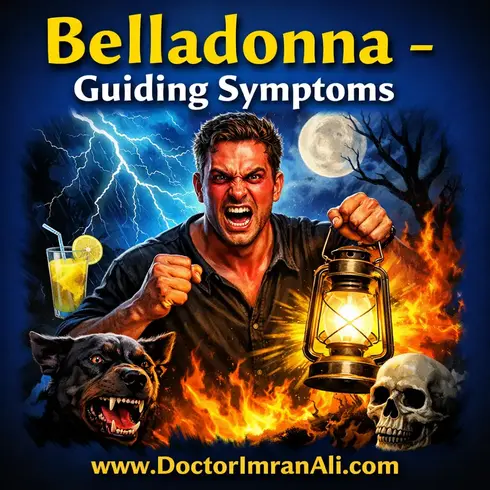
Now let’s break belladonna down into its most characteristic features.
- Suddenness of onset
- Intensity or explosiveness of symptoms
- Congestion and inflammation
- Heat or fever
- Redness of the parts involved
- Pulsating sensations and throbbing pains
A good way to think of the belladonna state is that it involves a sudden rush of blood to a part of the body. The particular part then becomes red, hot, inflamed, and feverish, and it pulsates with pain. We could say that this congestion of blood is an underlying theme that characterizes much of belladonna’s pathology.
Nature of Belladonna Symptoms
Belladonna symptoms are intense, acute, violent, and explosive. They come on very suddenly and tend to settle down just as quickly. The involved parts are congested with blood, and as a result, they become very red and hot, often bright red.
“The belladonna state is often associated with high fever.”
Few Clinical Examples of Belladonna
Belladonna Ear Infection
Now, imagine for a moment the child with a belladonna ear infection. Fever rises suddenly and dramatically. Blood rushes to the ear, which then becomes bright red. The eardrum is red and bulges outward, pulsating violently and painfully. It goes boom boom boom.
Migraine Headaches of Belladonna
Now imagine a similar scenario in a chronic case of migraine headaches. With each migraine, blood rushes suddenly to the head. The face becomes bright red and hot. And the head pounds and pulsates painfully.
Other Belladonna Situations
This rush of blood can occur in different body parts under different circumstances. Blood may suddenly rush to an injured body part, which then becomes very red.
- Blood may rush to the uterus during the menses.
- The blood pressure can spike in a person with hypertension, along with a hot flushed feeling in the body.
- Blood may rush to an inflamed tonsil that becomes swollen and painful.
In all such cases, the phenomenon is basically the same:
“The belladonna state involves a sudden, dramatic congestive or inflammatory event that results in heat, redness, and throbbing.”
This is not a remedy for subtle or mild symptomatology.
Generals of Belladonna
All right now, let’s talk about some additional belladonna clues, beginning with some of the generals.
Warm Blooded – Hot Face/Head + Cold Hands & Feet
Generally speaking, Belladonna is warm-blooded, and there can be flushes of heat.
However, many belladonna types are prone to having a red hot flushed face accompanied by cold hands and feet. This makes sense when we understand that the blood often rushes to the head and away from the extremities.
This can happen, for example, during fevers, hot flashes, migraines, or spikes in blood pressure.
Plethoric Remedy (Blood Flow + Inflammation)
The old books refer to belladonna types as being plethoric, meaning that they are full of blood and prone to inflammation.
Red Host Face
They have a red, robust appearance and a tendency to flush easily with heat and redness of the face.
Big, Strong, and Powerful Body Type
My own observations have led me to think that constitutional belladonna types are big, strong, and powerful. And although usually quite friendly, they have a strong presence and they tend to come on strong.
But more about this later when we get to the mentals.
Right-Sidedness
Now, another important general is that belladonna symptoms tend to have a distinct right-sidedness. There can be right-sided headaches, right-sided ovarian pains or ovarian cysts, and even right-sided facial convulsions.
Desire For Lemons, Sour Things in Belladonna
The main standout belladonna food preference is a desire for lemons or lemonade. This preference for sour is not always present, but when it is, it’s a good confirmatory clue for belladonna.
Thirstlessness of Belladonna
Another clue is thirstlessness or an aversion to liquids, especially during acute febrile (fever) conditions.
Belladonna and Calcarea Carbonica Similarities
One more general worth noting is that there’s a lot of overlap between belladonna and Calcarea carb. The two remedies have a very strong relationship, and so it can sometimes be difficult to tell the two apart.
Modalities of Belladonna
Now let’s take a look at some of the belladonna modalities. Two main modalities stand out above all others, which are Time Modalities & Aggravation from Jarring.
Symptoms Aggravation at 3 PM
The first is an aggravation of symptoms at 3 p.m. I always think of belladonna when a fever begins or peaks around this time. This time modality can also apply to other symptoms, especially chills or headaches.
Aggravation from Jarring
The other prominent modality is an aggravation from jarring. To jar something means to suddenly or forcefully shake it or move it. The person with the pounding belladonna headache wants to lie quietly in the dark. And accidentally bumping into the edge of the bed can be jarring and will trigger a wave of pain.
Additional modalities related to jarring are:
- An aggravation from motion
- An aggravation from stepping
- An aggravation from coughing
- An aggravation from touch
Headache Modalities
The belladonna headache is worse from light, worse from noise, better from lying in the dark, and better from firm pressure.
Environmental Modalities
In terms of environmental factors, belladonna symptoms can be aggravated by changes in temperature. This includes worse from becoming chilled and worse from being overheated.
We may also see an aggravation from the heat of the sun and an aggravation from a draft of air.
Belladonna is the strongest remedy listed under both:
- Head pain from getting the head wet
- Headache from cutting the hair.
Swallowing and Visual Triggers of Belladonna
An additional modality includes worse from swallowing. This applies especially to throat pain.
Aggravation From Seeing Running Water & Shining Objects
And lastly, there can be an aggravation from seeing running water or looking at shining objects.
These two modalities are related to the belladonna mental state, which is up next in our discussion.
Mental State of Belladonna
The belladonna mental state can be just as sudden, explosive, and violent as its physical symptoms. And we’re most likely to see this kind of behavior during the altered state of a feverish delirium. It can also be associated with psychiatric illness, especially during acute flare-ups of mania or Sycosis.
Belladonna Fear & Aggression Compared With A Rabid Animal
The belladonna state of fear and aggression can be likened to the behavior of a rabid animal. This rabid mindset or hydrophobic state is characterized by paranoid terror and explosive rage. The person may be gripped by a furious or ferocious rage(extreme violent anger).
It’s the kind of rage that is fueled by surges of adrenaline. Hence, rage may be accompanied by surges of superhuman strength. It can be extremely difficult to handle persons who are in this kind of delirious or psychotic state. A person in this state can be highly reactive and may suddenly lash out in anger.
In this altered state of violent, feverish, or sycotic delirium, the person will act wildly and do wild things.
- He may tear things to pieces.
- He may try to set something on fire.
- He may strike others, pull their hair, or spit at them.
- He may even growl or bark just like an angry rabid dog.
Biting Behavior of Belladonna Patient
However, the one most commonly seen behavior in this altered belladonna mental state is biting. There’s a strong tendency to bite, and they’ll try to bite just about anything, including themselves.
Belladonna is the only remedy listed under:
- Mania madness spits and bites those around him.
Belladonna and Stramonium are the two most prominently listed remedies under:
- Biting in delirium.
Belladonna also lists prominently under:
- Rage with biting
- Biting people
- Biting oneself
- Biting in children
- Biting objects
- Biting his own hands
- Biting everything
A Case of a Violent Lady in a Psychiatric Ward Biting Others
I’ll never forget the time back in medical school when I was accompanying a psychiatrist on rounds in the psychiatric ward of a hospital. I was shocked to see this very large woman with a bright red face who was restrained in her bed. She was essentially tied down to prevent her from biting. Her frenzied state of mind (out of her senses) caused her to bite at anyone or anything she could get her hands on.
Looking back, I feel sad that we have such a closed-minded medical system that arrogantly refuses to consider a therapy like homeopathy. A therapy that no doubt could have released that poor woman from her misery and suffering.
Fears of Belladonna
Now, the flip side of belladonna’s rage is fear. In fact, fear and rage (violent & uncontrollable anger) can alternate with each other. And the rubrics that most accurately represent Belladonna’s fears are the escape rubrics.
“The essence of belladonna’s fear is a feeling that one must escape from a sudden threat to his or her life.”
In his delusional or delirious state of mind, he is beside himself with terror and believes that he is in danger. He must hide or escape from whatever it is that he thinks is pursuing him. These threats can present themselves as delusions, visions, fears, or even dreams. When in this altered state, he may have hallucinations about these things that pose a threat to him. He may have visions of enemies, snakes, fire, hideous faces, or monsters.
Repertory Rubrics Related To Fear & Delusions of Belladonna
Many of belladonna’s fears and delusions are listed prominently in the repertory.
They include the following:
- A desire to escape
- Escape desire to escape in delirium
- Delusions of animals
- Delusions of insects
- Delusions of devils
- Delusions of dogs
- Delusion that he sees faces
- Fear of animals
- Fear of dogs
These visions may become worse when he tries to close his eyes.
Fear of Water and the Hydrophobic Miasm of Belladonna
One additional prominent belladonna fear is a fear of water. And this brings us back to the idea of the hydrophobic miasm. Hydrophobia is a fear of water, and it’s a very common symptom in cases of rabies.
The hydrophobic state is characterized by:
- Rage and aggression
- Hallucinations
- A feeling of being under threat
- Fear of water
- A sense of suffocation
- An aggravation from seeing running water
- An aggravation from seeing shining objects
Additional hydrophobic features include:
- Grinding of the teeth,
- Staring,
- Aversion to liquids
- Desire for light.
While these hydrophobic symptoms can occasionally be traced to an actual case of rabies or the rabies vaccine, the vast majority of cases that display such traits will have no connection whatsoever to rabies in either the personal or family history. So this hydrophobic miasm idea is really just a convenient and effective way of thinking about these types and patterns of symptoms.
Constitutional Features of Belladonna Patient
Now it’s also important to understand that most belladonna cases are not going to exhibit such extreme psychological symptoms.
“Most of the time, we prescribe this remedy based on physical symptoms alone.”
We give it most often when we see a sudden onset of high fever, intense redness, and pulsating pains.
Belladonna Are Big, Strong, Powerful People
Interestingly, my personal experience of the belladonna constitutional type is that they are big, strong, powerful people with strong personalities.
Vigorous & Intense
They often have a lot of Calcarea carb traits, but they’re also vigorous and intense.
Friendly, Lively, Extroverted
They’re friendly, lively, extroverted, and full of energy.
Cheerful & Talkative
They’re exuberant(full of energy), loquacious(talkative), and cheerful. When I see a patient in pain & fever and still smiling I think about prescribing Belladonna.
Temperament
While they may not present with complaints involving fear or anger, when asked about temperament, they may say something like Well, I’m not really an angry person, but boy, when I do get angry, watch out.
Physical Symptoms of Belladonna
Okay, so in most cases, we’re going to prescribe this remedy in acute situations. Symptoms develop suddenly in violent paroxysms and then settle down just as suddenly.
Symptoms we expect to see include:
- Great redness
- Pulsating pains or sensations.
- Pain can also be sharp or shooting.
High Fever Symptoms
High fever with a:
- Bright red hot face,
- Dilated pupils,
- Throbbing carotid arteries
- Cold hands and feet.
Dry Mouth, No Thirst & Desire For Lemons
There may be thirstlessness with a dry mouth or a desire for lemonade.
Rush of Blood, Inflammation, Redness
Recall that blood rushes to the affected part which then becomes bright red and inflamed and pulsates with pain.
Hot, Dry, Shiny Skin
The skin of the affected area is hot, dry, and can turn a shiny scarlet red.
Fever Starts or Aggravates at 3 PM
The belladonna fever often begins or peaks at around 3:00 p.m.
Very High Fever With Delirium, Rage, or Hallucination
When the condition is severe enough or the fever is high enough, we may see delirium with fear, rage, or hallucinations.
Belladonna is listed in the repertory under:
- Intense fever with delirium
- Furious delirium with burning fever
- Confusion of mind during fever
- Mania during fever
- Rage during fever
- Screaming during a fever
Now, just like Nux vomica for hangovers, belladonna has an exaggerated reputation for being the main remedy for fevers.
This simply isn’t so. Many remedies can fit fevers. I don’t recommend reflexively giving belladonna at the first sign of a fever without first thinking about the situation. It’s always important to observe and evaluate before choosing a suitable remedy.
Circulatory Symptoms of Belladonna
Now it makes sense that belladonna would be a fitting remedy for circulatory problems or imbalances. We’ve already seen how it involves the congestion of blood to a part, resulting in great redness. Pain is throbbing or pulsating, and there may be a full, bounding pulse.
Remedy For Hypertension
Belladonna can be a remedy for hypertension, especially when the blood pressure tends to shoot up suddenly.
Cold Hands & Feet
Just as blood rushes to the affected part, it also runs away from other parts, especially the hands and feet, which tend to become cold.
Vascular Migraine of Belladonna
Belladonna is also a remedy for vascular migraines. The typical migraine is right-sided and extends from the occiput or back of the head to the right frontal region above the right eye.
Of course, the onset is sudden,n and the pain is severe and throbbing. It can be worse at 3 p.m. and is usually worse from being jarred and from light. The headache is better from cold applications and from wrapping up the head. The pupils may be dilated, and there can be a corresponding sensitivity to light.
Vertigo Symptoms of Belladonna
Now, sticking with the head symptoms, belladonna can be an effective remedy for treating cases of vertigo. The vertigo is usually worse from turning the head, worse from turning in bed, and worse from bending forward.
Ear Infection of Belladonna
A belladonna ear infection, not surprisingly, is right-sided, throbs violently, and the pulsation may be synchronous with the beating of the heart.
Of course, the ear is also bright red, either internally or externally.
Sore Throat of Belladonna
Lastly, a belladonna sore throat is similarly right-sided, red, and swollen, and aggravated from swallowing.
Female Symptoms of Bellaonna
Now, belladonna can also be indicated for a variety of female health problems.
Painful, Heavy Menses With Hot, Red Blood
The menses can be painful and very heavy, and the blood is typically bright red with large dark clots. The blood can be hot, and I’ve had patients tell me that it comes in gushes with each beat of the heart.
Mastitis
In cases of mastitis(swelling and redness, inflammation of breast tissue), there’s a fever, and the breast is bright red and hot, and aggravated by jarring.
Nervous System Diseases That Can Be Treated With Belladonna
Now, as we’ve already seen, belladonna is a remedy that profoundly affects the brain and nervous system.
Meningitis, Encephalitis, Hydrocephalus & Seizure Disorders
It can be a remedy for meningitis, encephalitis, hydrocephalus, and seizure disorders. There can be twitching and jerking, and spasms of muscles associated with all kinds of conditions.
Neuralgic Pains
There may be increased sensitivity of the senses, and sometimes we see neuralgic pains.
Jerking During Sleep
There can be kicking and jerking during sleep.
Brain Problem With Pressing Head into Pillow
One particular belladonna symptom that points to the likelihood of a brain problem is pressing the head into a pillow.
Seizure With High Fever
Finally, we must always consider belladonna when a seizure is brought on by a high fever.
Remedy Relationships of Belladonna
Calcarea Carb (Complementary)
All right, so there’s a very strong relationship between Calcarea carb and belladonna. They’re considered complements, and Calcarea carb acutes will often respond favorably to belladonna.
Remedies worth comparing to belladonna include:
Aconite (Sudden, Acute)
Aconite, which is also indicated for sudden acute conditions, especially fevers with great symptomatic intensity.
Apis Mellifica
Apis likewise is right-sided and known for its heat, redness, amelioration from cold applications, and lack of thirst.
Stramonium
Stramonium is another hydrophobic remedy that can also be explosive, rageful, terror-stricken, convulsive, and delirious.
Hyoscyamus and Lyssin (Hydrophobinum)
Hyoscyamus and Lyssin, aka hydrophobinum, are also hydrophobic remedies that have many traits in common with both stramonium and belladonna.
Glonoinum
Glonoinum, which is made from nitroglycerin, is another explosive remedy that treats hypertension and congestive headaches with violent pulsating.
Sanguinaria
Sanguinaria has very similar right-sided migraines that begin in the occiput and extend to the right frontal region. It also fits flushes of heat and hypertension.
Amyl Nitrite
Lastly, Amyl nitrite produces hypertension and facial flushing with violent pulsations throughout the body.
Last Words
Okay, that’s my take on belladonna. I hope you found it helpful. Thanks for reading. I always appreciate your questions and comments.
Need an Online Homeopathic Consultation?
We offer online homeopathic consultation worldwide. You can submit your case, and we will get back to you ASAP.

Homeopathic Dr. Imran Ali, DHMS, BHMS (Gold Medalist, University of Peshawar), RHMP, is a qualified homeopathic physician with over 10 years of clinical experience. He is registered with NCH (Reg. No. 170600) and focuses on safe, individualized, and holistic homeopathic care. Author of the Kindle book “Homeopathy For Infants & Kids – Curing 165 Most Common Issues” – available on Amazon.