Introduction: Lycopodium Clavatum (Club Moss)
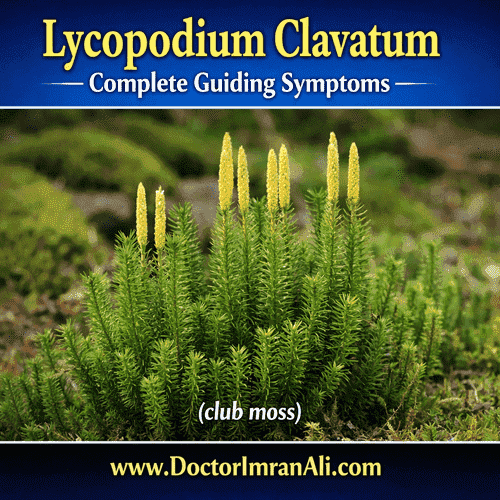
Hi. I’m Dr Imran Ali, and welcome back to the homeopathy materia medica series. Today I’ll be talking about the homeopathic remedy Lycopodium, which is a plant-based remedy derived from club moss. The genus and species of this particular moss is Lycopodium Clavatum. Lycopodium is a major polycrest. It’s a frequently indicated remedy for both acute and chronic conditions.
It’s so commonly indicated that it’s worth beginning by identifying a few core elements that make Lycopodium easy to recognize. Those elements include:
- A strong desire for sweets.
- A tendency to develop right-sided symptoms.
- Right-sided symptoms that move over to the left.
- General aggravation of symptoms between 4 and 8 pm.
- A variety of digestive complaints, but especially gas and bloating.
- And issues that stem from a lack of self-confidence.
Of course, there’s much more to this important polycrest, but if you begin by memorizing this short list, you’ll have a basic grasp of Lycopodium.
Now let’s discuss the remedy in more depth.
Lack of Confidence in Lycopodium Clavatum
Contradictory Mix of Both Insecurity & Overconfidence
On the psychological level, Lycopodium suffers from a lack of confidence. However, that lack of confidence is not always obvious because it’s frequently disguised or hidden. Lycopodium commonly presents as an interesting, contradictory mix of both insecurity and overconfidence.
Lycopodium tries to hide its Lack of Confidence
These patients tend to compensate for their lack of confidence by trying to come across as confident or competent. This compensatory bluster is often overdone, such that it can feel more like bravado (a swaggering show of courage) or cockiness (excessive, annoying self-confidence).
Ted Baxter is an Example Personality of Lycopodium
I think of the fictional TV newscaster Ted Baxter from the Mary Tyler Moore show as the ultimate caricature of Lycopodium. He puffs himself up on the air to make himself sound authoritative and important, but off the air, he’s a cowardly man ridden with insecurities.
Outer Display of Ego, Inner Feeling of Weakness
So what we see in Lycopodium is an outer display of ego designed to compensate for an inner feeling of weakness, insecurity, incompetence, or inferiority. That’s not to say that they’re necessarily conscious of their compensatory behavior. It’s mostly an instinctive means of self-protection.
Lack of Confidence in Terms of Performance and Appearance
Lycopodium often lacks confidence in terms of their performance and in terms of how they appear to others. They fear being wrong or making mistakes or looking stupid. They’re concerned about what others think. They don’t want to appear foolish or to be embarrassed.
Cowardliness, Timidity, especially in New Situations
In the homeopathic books, this insecurity is often described as cowardliness. This low self-esteem often translates into timid behavior, especially in new situations or unfamiliar settings where the person is a newcomer.
Indecision or Irresolution
This fear of the public’s judgment can also lead to indecision, or, as they say in the homeopathic literature, irresolution.
Avoid Taking Responsibilities
Lycopodium’s lack of confidence may cause them to avoid responsibilities.
Lycopodium is listed in the repertories under:
- Aversion to marriage
and the idea of marriage seems unendurable. Of course, in a relationship as intimate and full of responsibility as marriage, one’s weaknesses can be easily exposed.
Fear of Failure in Lycopodium
We tend to see the same basic picture in both children and adults who need Lycopodium.
Children’s Fear of Giving Wrong Answers
The child may not want to engage me in the consulting room for fear of getting the answer wrong, even though there are no wrong answers. And he or she may get upset if corrected in front of me by the parent or if made to look wrong.
This is a good example of how homeopathy is a medicine of experience because these are usually not the kinds of details that are volunteered in consultation. They must be observed by the practitioner. Oftentimes, parents don’t want to admit such things about their children.
Lycopodium Kids Won’t Try New Things Due to Fear of Failing
Many Lycopodium children won’t even try new things for fear of failing. One question the parents may admit that the child won’t try anything new unless he’s certain that he can do it well. He gives up on challenging homework assignments before even trying because he fears he can’t complete them.
Of course, that tends to create an impossible catch-22. After all, how can one know unless one tries?
Dictatorial Behaviour of Lycopodium at Home
Now the interesting thing is that Lycopodium often has a flip side. For example, the adult may be quiet in the workplace but demanding at home. The child may be shy in unfamiliar settings but overconfident around friends and family. This Jekyll and Hyde quality can be quite striking (A person has two very different sides to their personality).
And Lycopodium child may be shy in the office, but he becomes a little dictator at home. Lycopodium is the most prominently listed remedy in the repertory under the rubric:
- Dictatorial.
This overcompensation for inner insecurity can manifest as cockiness, bravado, bluffing, or bragging.
Haughty And Egotism
Lycopodium may try to give the impression that he is the exact opposite of what he feels inside. He may make himself the center of attention, speaking with an air of command, entertaining, and telling stories.
Lycopodium is listed prominently in the repertory under:
- Haughty
- Egotism.
Lycopodium is confident within his or her area of expertise. In family settings and at home, he may also be dictatorial, especially around underlings, as in the behavior of an abusive boss.
Love of Power is a Core Feature of Lycopodium
Lycopodium is the strongest remedy listed under:
- Love of power.
Positions of power and authority may be used and even abused to cover up inner feelings of insecurity and inferiority. It makes sense, therefore, that some Lycopodiums would seek acceptance through social status and positions of power.
Lycopodium is Bossy
Bossy is a great word to describe some Lycopodium types. And it’s a good word to use when asking parents about their child’s behavior. You can see their eyes light up in recognition when the parents acknowledge that Oh yes, he is bossy.
In fact, I’ve seen Lycopodium kids contradict their parents right there in front of me in the office. The child may even try to turn the tables on the parent, acting as if he is the authority figure.
When asked, the parents will admit that their child tries to tell them what to do or frequently corrects them, telling them that they’re wrong even when the parents are in the right. I’ve seen this happen many times.
For example, the parent says we went to the beach last week. And the child quickly interrupts, “No, it was two weeks ago”. The parent says, “No, honey, it was last week”. But the child insists it was two weeks ago. The funny thing is that the child may act shy toward me while at the same time acting bossy toward the parents. As always, nothing is written in stone.
Contradiction
It’s not surprising that Lycopodium is listed under the rubric:
- Dispositioned to contradict.
In addition, Lycopodium may be intolerant of any contradiction.
Fears of Lycopodium Clavatum
People who need Lycopodium can manifest behaviors anywhere along this polarity between low self-esteem and overconfidence. Some may present with minimal egotism, while others may hide their insecurity so well that it’s hard to detect at all.
Many display a mixture of both characteristics.
So, as you can see, most of Lycopodium’s fears center around how they think others perceive them. This may take the form of a:
- Fear of approaching others.
- Fear of confrontation.
- Fear of being embarrassed.
- Fear of failure.
- Fear of everything.
- Fear of exams.
- Fear of commitment.
- Fear of men.
- Fear of the opinions of others.
- Fear of people.
- Fear of responsibility.
- Fear of new situations.
- Fear of not being good enough.
- And fear of public speaking.
Digestive Problems of Lycopodium
On the physical level, Lycopodium tends to have a lot of digestive complaints.
Bloating, Belching, Flatulence
The most common digestive symptoms include:
- Stomach bloating and flatulence.
- There can also be indigestion and belching.
Many homeopathic books refer to belching as eructations.
Fullness From Eating a Small Amount of Food
Lycopodium has the keynote symptom of fullness from eating even small amounts of food. The patient will complain that he feels hungry, has just a few bites, then feels full and is no longer hungry.
Liver & Gallbladder Problems
Lycopodium has a strong affinity for the liver and gallbladder and can be helpful in all sorts of problems affecting those organs, like gallstone colic or hepatitis.
Other illnesses With Gastric Issues
The association with digestive troubles is so strong that it’s worth considering Lycopodium whenever we see illnesses with gastric concomitants.
For example
- Headaches with stomach symptoms.
- Asthma with abdominal bloating.
- Heart palpitations associated with flatulence.
Pressure of Clothing Aggravates Symptoms
A common Lycopodium modality is that the pressure of clothing can aggravate the abdominal symptoms. The patient wants to loosen the belt, untuck the shirt, or unbutton the pants in order to bring relief to the discomfort.
Right-Sided Symptoms of Lycopodium
Now, Lycopodium is famous for its tendency to develop right-sided symptoms or, more importantly, symptoms that start on the right and move to the left. The uniqueness of Lycopodium is that the right-sided symptoms can either extend over to include the left or can switch to the left side.
In other words, a right-sided shoulder pain, for example, may switch to the other shoulder so that it’s only on the left. Or shoulder pain that began on the right can move over to include the left so that both shoulders are painful.
Either way, this is a very strong indication for Lycopodium.
We may see this right-sided or right-to-left pattern in:
- Headaches
- Ovarian conditions
- Sciatica
- Eczema
- Psoriasis
- Sore throats
- and more.
Of course, many digestive complaints originate in the liver and gallbladder, both of which are located on the right side of the body.
Generals of Lycopodium Clavatum
Some important Lycopodium General Symptoms include the following.
A strong desire for sweets.
Lycopodium, along with Argentum nitricum and China, are the three remedies in the materia medica with the most striking sweet craving.
Desires Starchy Foods
Lycopodium can also have a desire for starchy foods.
Difference b/w Sweet & Starchy Things
Note that while some health-conscious patients may refer to sweets and starches as one in the same for homeopathic purposes, they are not. Sweets are things like cookies, cakes, candies, and ice cream, and starches include things like pasta, bread, rice, grains, and potatoes.
Lycopodium is Chilly
Another general is that most Lycopodium cases tend to be chilly.
4-8 PM Aggravation
In terms of modalities, Lycopodium has the famous 4 pm or 4 to 8 pm aggravation time.
Amelioration from Warm Drinks & Vice Versa
Other modalities include amelioration from warm drinks and aggravation from cold drinks.
A Classic Example of Lycopodium Sore Throat
The classic Lycopodium sore throat presentation consists of throat pain that begins on the right side, moves to the left side, feels better from warm drinks, and is aggravated by cold drinks.
Food Modalities
Food modalities include:
- Aggravation from onions
- Aggravation from shellfish.
Additional Symptoms of Lycopodium
Additional Lycopodium keynote symptoms or clues include:
Flaring Nostrils
Flaring nostrils in infants with respiratory distress.
Stuffy Nose Chronic
Chronic stuffy nose that is worse at night in bed.
Sniffles
Another nasal symptom is a tendency toward sniffles or snuffles
Dyslexia
And finally, Lycopodium may be indicated in cases of dyslexia in which the person transposes numbers or letters while writing. For example, while intending to write the number 68, the person may mistakenly write 86.
Remedy Relationship of Lycopodium Clavatum
Since Lycopodium is a polycrest, it’s important to be aware of its relationships with other remedies.
Lachesis is a Complementary Remedy
Firstly, Lycopodium has a famous complementary relationship to Lachesis. The two remedies are commonly needed one after the other.
Remedies Working in Sequence With Lycopodium
Other remedies that may work in sequence with Lycopodium are Calcarea Carb, sulfur, Sepia Phosphorus, and Baryta Carb.
Chelidonium (Digestive Issues)
In digestive troubles, Chelidonium can be a complement to Lycopodium because of their digestive similarities.
Compare to China and Natrum Sulph
It’s also important to compare China and Natrum Sulph to Lycopodium.
Ambra, Silicea, Gelsemium & Baryta Carb (Low Self-Esteem)
Remedies to compare in cases of low self-esteem include Lycopodium are Ambra, Baryta Carb, Silica, and Gelsemium.
Platina, Sulphur, Baryta Mur (Haughty Remedies)
Remedies that are similarly haughty and domineering are Platina Sulfur and Baryta muriatica.
Ferrum Met, Hepar Sulph, Ignatia, Lachesis (Intolerant of Contradiction)
Remedies that are also contrary or intolerant of contradiction include Ferrum Met, Hepar Sulph, Ignatia, and Lachesis.
Anacardium & Hepar Sulph (Dichotomy b/w Lack of Confidence and Overconfidence)
And finally, we see a similar dichotomy between lack of confidence and overconfidence in the remedies Anacardium and Hepar sulf, although to a much greater extent than in Lycopodium. The difference when compared to Lycopodium is that both of these remedies may compensate for their insecurities through a more extreme type of abusiveness or aggression. They may even be cruel.
Summary of Key Points of Lycopodium
Okay, so let’s summarize Lycopodium one more time.
- Strong desire for sweets.
- Right-sided symptoms or symptoms that move from right to left.
- Aggravation between 4 and 8 pm.
- Digestive problems.
- And lack of self-confidence.
My intention in the materia medica series is to give clear, concise overviews of each remedy. With these basic foundations in place, you can then add to your knowledge through further study and practice. Thanks for reading.
Get Personalised Homeopathic Consultation Online
Submit your detailed case, pay the consultation fee securely, and receive professional online homeopathic guidance. Your case will be carefully studied, and individualized remedy advice will be provided based on complete symptoms and history.

Homeopathic Dr. Imran Ali, DHMS, BHMS (Gold Medalist, University of Peshawar), RHMP, is a qualified homeopathic physician with over 10 years of clinical experience. He is registered with NCH (Reg. No. 170600) and focuses on safe, individualized, and holistic homeopathic care. Author of the Kindle book “Homeopathy For Infants & Kids – Curing 165 Most Common Issues” – available on Amazon.